
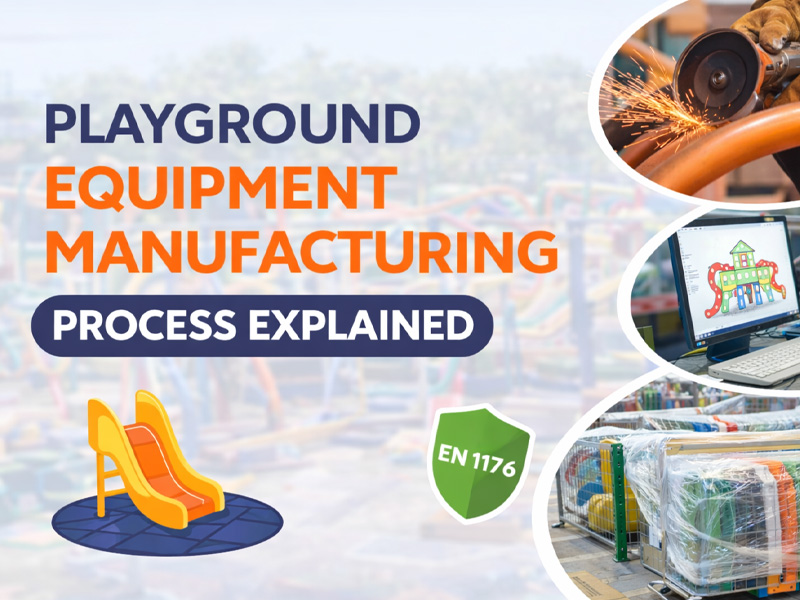
The global demand for safe, durable, and engaging playground equipment continues to grow as schools, parks, municipalities, and commercial developers invest in child-friendly infrastructure. Behind every well-designed playground lies a complex and carefully controlled manufacturing process that ensures safety, compliance, longevity, and play value.
Understanding the playground equipment manufacturing process is essential for buyers, project planners, and facility managers. It helps decision-makers evaluate supplier capabilities, assess product quality, and ensure compliance with international safety standards such as EN1176, ASTM F1487, and CPSIA.
1. Concept Development and Design Planning
Market Research and User Needs
The manufacturing process begins with research. Manufacturers analyze:
- Target age groups (toddlers, children, teenagers)
- Installation environments (indoor playgrounds, outdoor parks, schools)
- Regional safety regulations and climate conditions
- Current design trends and play behavior studies
This phase ensures that equipment is not only visually appealing but also developmentally appropriate and culturally relevant.
CAD Modeling and Engineering Design
Professional designers and engineers use CAD and 3D modeling software to:
- Define structural dimensions and load-bearing capacity
- Simulate user movement and stress points
- Optimize layouts for safety zones and fall heights
Well-developed designs reduce manufacturing errors and improve safety performance before production begins.
2. Material Selection and Safety Considerations
Common Playground Materials
High-quality playground equipment relies on carefully selected materials, including:
- Galvanized steel or stainless steel for structural frames
- LLDPE or HDPE plastic for slides and panels
- Aluminum and reinforced nylon for connectors
- Soft padding, EVA foam, and netting for indoor playground systems
Each material is chosen for durability, weather resistance, and child safety.
Compliance With Safety Standards
Materials must meet international requirements for:
- Non-toxicity and lead-free composition
- UV resistance and temperature stability
- Fire resistance (especially for indoor playgrounds)
Certified raw materials form the foundation of compliant playground equipment manufacturing.
3. Cutting, Forming, and Fabrication
Metal Processing
Steel and aluminum components are:
- Laser-cut or CNC-cut for precision
- Bent and welded using automated or robotic systems
- Treated to eliminate sharp edges and weld stress points
Accurate fabrication ensures structural integrity and long-term performance.
Plastic Rotational Molding
Slides and enclosed components are often produced through rotational molding, which:
- Creates seamless, uniform wall thickness
- Improves impact resistance
- Allows complex shapes and bright colors
This method is widely used for high-quality outdoor slides and tunnels.
4. Surface Treatment and Finishing
Anti-Corrosion Treatments
Metal components undergo:
- Hot-dip galvanization
- Zinc spraying
- Anti-rust primers
These treatments protect equipment from moisture, salt, and temperature fluctuations.
Powder Coating and Color Application
Powder coating provides:
- UV resistance
- Smooth, child-safe surfaces
- Long-lasting color retention
Bright colors improve visibility and enhance the play environment.
5. Assembly and Pre-Installation Testing
Modular Assembly
Manufacturers assemble components into modular systems to:
- Verify dimensional accuracy
- Test alignment and fit
- Identify potential assembly issues early
This step reduces on-site installation errors.
Structural and Load Testing
Before shipment, equipment undergoes:
- Static load testing
- Dynamic stress simulation
- Connection and fastener inspections
Testing confirms that equipment meets or exceeds safety requirements.
6. Quality Control and Certification
Multi-Stage Quality Inspection
Professional manufacturers implement:
- Incoming material inspections
- In-process quality checks
- Final pre-shipment inspections
Each stage is documented for traceability.
Third-Party Certification
Many projects require independent testing and certification, such as:
- EN1176 compliance reports
- ASTM F1487 testing
- ISO 9001 manufacturing systems
Certification enhances buyer confidence and regulatory acceptance.
7. Packaging, Logistics, and Global Shipping
Protective Packaging
Playground equipment is packaged using:
- Protective foam and corner guards
- Moisture-resistant wrapping
- Clearly labeled components and hardware kits
Proper packaging prevents damage during long-distance transport.
Export and Logistics Coordination
Manufacturers experienced in international trade manage:
- Export documentation
- Container loading optimization
- Delivery scheduling
This ensures smooth project execution for overseas buyers.
8. On-Site Installation and Post-Sales Support
Professional Installation
Installation teams follow:
- Manufacturer guidelines
- Safety zone requirements
- Local construction regulations
Correct installation is critical to equipment performance and liability management.
Maintenance Guidance and Warranty
Reputable manufacturers provide:
- Maintenance manuals
- Inspection schedules
- Long-term warranties and spare parts support
This extends equipment lifespan and reduces total cost of ownership.
Conclusion
The playground equipment manufacturing process is a multidisciplinary system combining design expertise, engineering precision, material science, and rigorous quality control. From initial concept to final installation, each step plays a vital role in delivering safe, durable, and engaging play environments.
For buyers and project planners, understanding this process enables better supplier evaluation, improved safety outcomes, and long-term value. As technology and standards continue to evolve, transparent and professional manufacturing practices will remain the cornerstone of successful playground projects worldwide.
Frequently Asked Questions (FAQ)
1. How long does playground equipment manufacturing take?
Typically, 4–8 weeks depending on design complexity, materials, and certification requirements.
2. What safety standards should playground equipment meet?
Common standards include EN1176, ASTM F1487, CPSIA, and relevant local regulations.
3. Are custom playground designs more expensive?
Custom designs may cost more initially but often provide better space utilization and user engagement.
4. How long does playground equipment last?
With proper materials and maintenance, high-quality equipment can last 10–20 years.
5. Can manufacturers provide installation services?
Yes, many manufacturers offer on-site installation or remote technical guidance.


