
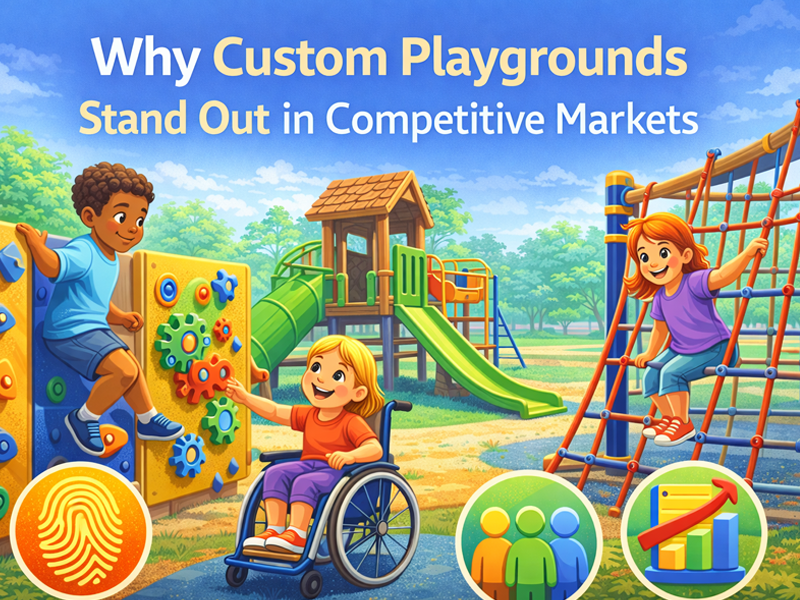
In today’s increasingly competitive leisure, education, and real estate markets, playgrounds are no longer viewed as simple recreational add-ons. They have become strategic assets that influence brand perception, community engagement, property value, and user satisfaction. Standard, off-the-shelf playground solutions may meet basic functional needs, but they often fail to differentiate a project in a crowded market.
Custom playgrounds, by contrast, offer tailored design, unique user experiences, and stronger alignment with project goals. From commercial developments and schools to municipalities and resorts, decision-makers are recognizing that customized playground solutions provide long-term value beyond initial installation.
Understanding the Shift Toward Custom Playgrounds
From Standardization to Differentiation
Historically, playground equipment focused on standardization for cost efficiency and ease of installation. While this approach reduced upfront expenses, it often resulted in repetitive designs that lacked character and engagement. As communities and commercial operators seek to stand out, differentiation has become a core requirement.
Custom playgrounds enable designers and owners to move beyond uniform layouts, offering themed environments, site-specific designs, and interactive features that reflect local culture, brand identity, or educational objectives.
Changing User Expectations
Modern users—children, parents, educators, and community stakeholders—expect more from play environments. They value creativity, inclusivity, and meaningful experiences. Custom playgrounds respond to these expectations by offering:
- Multi-sensory play opportunities
- Age-appropriate and ability-inclusive designs
- Engaging layouts that encourage social interaction
These factors significantly enhance user satisfaction and long-term usage.
Key Advantages of Custom Playgrounds in Competitive Markets
Unique Brand Identity and Market Positioning
In competitive markets, visual identity matters. A custom playground becomes a recognizable landmark rather than a generic facility. For commercial developments such as shopping centers, hotels, or residential communities, a distinctive playground reinforces brand positioning and supports marketing efforts.
Custom designs allow owners to integrate brand colors, logos, themes, and storytelling elements directly into the play environment, creating a cohesive and memorable experience.
Enhanced User Engagement and Longer Dwell Time
Standard playgrounds often lose appeal over time due to limited play value. Custom playgrounds are designed around user behavior, incorporating multiple play paths, challenges, and interactive features that encourage exploration.
This increased engagement leads to longer dwell time, which is especially valuable for commercial venues and public spaces aiming to increase foot traffic and community interaction.
Safety and Compliance Through Custom Design
Tailored Safety Solutions
Contrary to common assumptions, custom playgrounds do not compromise safety. In fact, customization allows for more precise risk management. Designers can adapt layouts to site conditions, user demographics, and local safety requirements.
Certified manufacturers ensure that custom playground equipment complies with international standards such as ASTM, EN, and local regulations, while still allowing creative flexibility.
Better Integration With the Environment
Custom playgrounds are designed with the installation site in mind. This reduces hazards associated with poor drainage, uneven terrain, or overcrowded layouts. By aligning equipment placement with natural surroundings, safety and usability are improved simultaneously.
Inclusivity as a Competitive Advantage
Designing for All Abilities
Inclusive play is no longer optional—it is a key differentiator. Custom playgrounds allow for intentional inclusion of children with different physical, sensory, and cognitive abilities. This includes:
- Wheelchair-accessible routes
- Sensory-rich play panels
- Quiet zones and adaptive equipment
Such features demonstrate social responsibility while expanding the user base.
Community and Social Impact
Inclusive custom playgrounds foster stronger community ties. Families are more likely to choose locations that accommodate all children, enhancing reputation and public perception for municipalities, schools, and developers.
Long-Term Value and Return on Investment
Durability and Lifecycle Efficiency
Custom playgrounds are typically built with higher-quality materials and site-specific engineering. This results in better durability, reduced maintenance costs, and longer service life compared to mass-produced alternatives.
While initial investment may be higher, the total cost of ownership is often lower over time.
Higher Perceived Value
A well-designed custom playground increases perceived value for surrounding properties and facilities. In residential and commercial projects, this can translate into higher occupancy rates, stronger buyer interest, and increased willingness to pay.
Flexibility and Scalability for Future Growth
Adaptable Design Concepts
Custom playgrounds can be designed with future expansion in mind. Modular planning allows new components to be added as budgets grow or user needs change, ensuring long-term relevance.
Alignment With Urban Development Trends
As cities evolve toward mixed-use and experience-driven spaces, custom playgrounds fit seamlessly into modern urban planning strategies. They support sustainability, placemaking, and community well-being initiatives.
Choosing the Right Custom Playground Manufacturer
Experience and Technical Expertise
To succeed, custom playground projects require collaboration with experienced manufacturers who understand design engineering, safety standards, and international compliance. Proven expertise ensures that creativity is supported by technical reliability.
Transparent Processes and Certifications
Reputable manufacturers provide clear documentation, certifications, and design validation. This transparency supports trust and ensures compliance with regulatory and insurance requirements.
Conclusion
Custom playgrounds stand out in competitive markets because they deliver far more than basic play functionality. They provide differentiation, stronger branding, enhanced safety, inclusivity, and long-term economic value. As user expectations rise and competition intensifies, investing in a custom playground is no longer a luxury—it is a strategic decision.
For developers, municipalities, schools, and commercial operators seeking to create meaningful, future-ready play environments, custom playgrounds represent a powerful tool to achieve both social and commercial objectives.
Frequently Asked Questions (FAQ)
1. Are custom playgrounds more expensive than standard ones?
Initial costs are often higher, but custom playgrounds typically offer better durability, lower maintenance costs, and higher long-term value.
2. Do custom playgrounds meet international safety standards?
Yes. Certified manufacturers design custom playgrounds to comply with ASTM, EN, and other applicable safety standards.
3. How long does it take to design a custom playground?
The design timeline varies by complexity, but most projects include concept design, approval, and production phases that ensure accuracy and compliance.
4. Can custom playgrounds be inclusive?
Absolutely. Custom design allows full integration of inclusive and accessible play features for children of all abilities.
5. Are custom playgrounds suitable for small spaces?
Yes. Custom solutions are especially effective for limited or irregular spaces, maximizing play value without overcrowding.


