
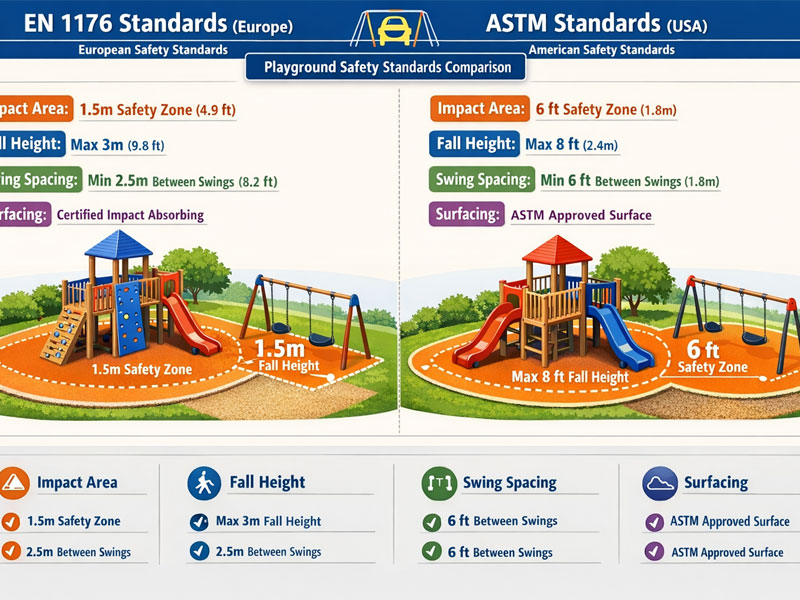
Playground equipment safety standards play a critical role in ensuring safe and reliable play environments for children. For buyers, designers, and operators of commercial playgrounds, understanding the differences between EN 1176 and ASTM playground safety standards is essential when planning projects for Europe, North America, or international markets.
Based on our experience manufacturing and supplying playground equipment for global projects, this article provides a clear and practical comparison of Playground Equipment Safety Standards: EN1176 vs ASTM, helping decision-makers choose the appropriate standard for their specific application.
Why Playground Equipment Safety Standards Matter
Playgrounds are public-use facilities with a duty of care toward children. Safety standards exist to:
- Reduce the risk of injury
- Establish consistent design and testing criteria
- Support regulatory approval and inspections
- Protect operators from liability
For commercial playground equipment, compliance with recognized safety standards is not optional—it is a fundamental requirement.
Overview of Major Playground Safety Standards
Globally, the two most widely referenced playground safety standards are:
- EN 1176 – Primarily used in Europe
- ASTM Standards – Commonly used in the United States and Canada
Although both aim to improve playground safety, they differ in structure, testing methods, and regulatory context.
What Is EN 1176?
Definition and Scope
EN 1176 is a European Standard that specifies safety requirements and test methods for playground equipment intended for public use. It applies to playgrounds installed in:
- Public parks
- Schools and kindergartens
- Residential communities
- Commercial and municipal projects
EN 1176 consists of multiple parts, each covering specific equipment types and safety considerations.
Structure of EN 1176
Key parts of EN 1176 include:
- EN 1176-1: General safety requirements
- EN 1176-2: Swings
- EN 1176-3: Slides
- EN 1176-4: Cableways
- EN 1176-5: Carousels
- EN 1176-6: Rocking equipment
- EN 1176-7: Installation, inspection, maintenance
This modular structure allows detailed guidance for different equipment categories.
Key Characteristics of EN 1176
EN 1176 emphasizes:
- Risk assessment rather than risk elimination
- Clear definitions of fall height and free space
- Equipment-specific testing methods
- Installation and maintenance responsibilities
The standard encourages designers to balance safety with play value.
What Is ASTM Playground Equipment Standard?
Definition and Scope
ASTM playground standards are developed by ASTM International and are widely adopted in North America. The most relevant standards include:
- ASTM F1487 – Standard Consumer Safety Performance Specification for Playground Equipment for Public Use
- ASTM F1292 – Impact attenuation of surfacing materials
- ASTM F1951 – Accessibility of surfacing
ASTM standards are often referenced by local authorities and school districts in the United States.
Structure of ASTM Standards
Unlike EN 1176, ASTM standards are published as separate documents, each addressing a specific aspect of playground safety. ASTM F1487 serves as the core reference for equipment design and performance.
Key Characteristics of ASTM Standards
ASTM standards focus on:
- Performance-based testing
- Injury prevention through dimensional requirements
- Detailed specifications for entrapment, protrusion, and sharp edges
- Clear testing procedures for materials and components
The approach is generally more prescriptive compared to EN 1176.
EN 1176 vs ASTM: Key Differences Explained
1. Geographic Application
- EN 1176: Europe and regions adopting European standards
- ASTM: United States, Canada, and regions influenced by North American regulations
Choosing the correct standard depends primarily on project location and regulatory requirements.
2. Risk Philosophy
- EN 1176 allows for managed risk, supporting challenging play experiences
- ASTM emphasizes minimizing foreseeable risks through stricter dimensional controls
This philosophical difference can influence design creativity and play complexity.
3. Fall Height and Surfacing Requirements
- EN 1176 defines critical fall height and corresponding surfacing performance
- ASTM combines equipment requirements with detailed surfacing impact attenuation standards
Both standards require impact-absorbing surfaces but evaluate them differently.
4. Equipment Design and Testing
- EN 1176 includes equipment-specific test methods for swings, slides, and climbing structures
- ASTM provides comprehensive performance specifications with detailed measurement criteria
Manufacturers supplying both markets often design equipment to meet the stricter requirement of each standard.
5. Documentation and Inspection
- EN 1176 places strong emphasis on installation, inspection, and maintenance guidance
- ASTM focuses more heavily on design compliance and performance testing
Both standards require ongoing inspection and maintenance to maintain compliance.
Can Playground Equipment Comply with Both EN 1176 and ASTM?
Yes. Many commercial playground equipment manufacturers design products to comply with both EN 1176 and ASTM standards.
This typically involves:
- Designing to the most conservative dimensional limits
- Selecting materials that meet both testing methods
- Providing dual certification or test reports
Dual-compliant equipment is especially valuable for international projects.
How Safety Standards Affect Playground Equipment Selection
Understanding safety standards helps buyers make informed decisions regarding:
- Equipment height and layout
- Required safety surfacing
- Installation clearances
- Maintenance responsibilities
Early consideration of safety standards reduces redesign costs and approval delays.
The Role of Manufacturers in Safety Compliance
A professional playground equipment manufacturer supports compliance by:
- Designing equipment according to applicable standards
- Providing technical drawings and test documentation
- Offering installation and maintenance guidance
Manufacturer experience is a key factor in successful compliance.
Real-World Experience with EN 1176 and ASTM Projects
Based on our experience with playground projects in Europe and North America:
- European municipal projects typically require third-party testing to EN 1176
- U.S. school projects often reference ASTM F1487 alongside local codes
- International projects frequently request dual-standard compliance
Understanding these differences streamlines project planning and approval.
Common Misunderstandings About Playground Safety Standards
Some common misconceptions include:
- One standard is universally “better” than the other
- Compliance ends after installation
- Surfacing requirements are optional
In reality, safety compliance is an ongoing process involving design, installation, and maintenance.
Choosing the Right Standard for Your Project
When deciding between EN 1176 and ASTM, consider:
- Project location and local regulations
- Client or authority requirements
- Intended user age groups
- Long-term maintenance capabilities
Consulting experienced manufacturers early in the process helps clarify requirements.
Conclusion
Understanding Playground Equipment Safety Standards: EN1176 vs ASTM is essential for anyone involved in commercial playground projects. While both standards aim to protect users, they differ in philosophy, structure, and application. Choosing the appropriate standard—or designing for both—ensures safe, compliant, and successful playground installations.玩具列表


