
Currently Empty: $ 0.00
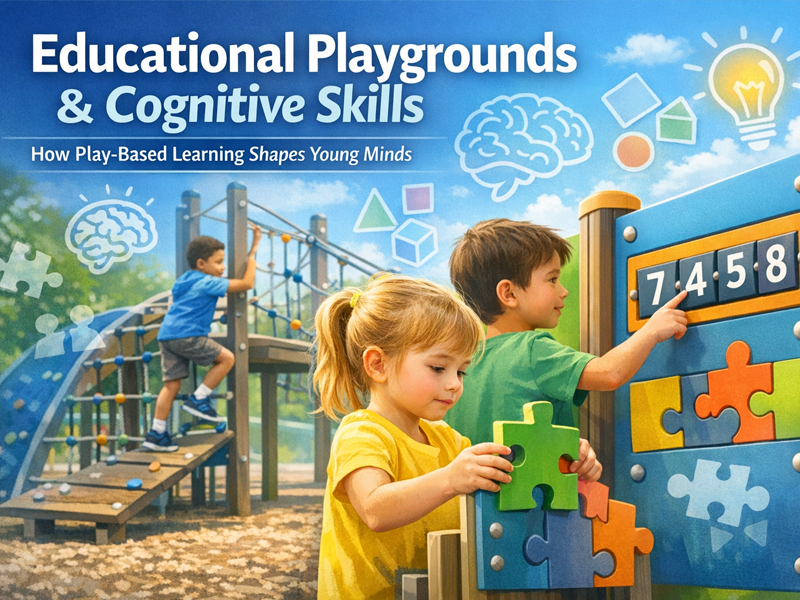
Educational playgrounds are no longer viewed as simple recreational spaces. In modern child development theory, they are increasingly recognized as powerful learning environments that actively support cognitive growth. By combining physical activity, social interaction, and problem-solving opportunities, educational playgrounds create conditions where children learn naturally through play. This approach aligns with well-established research in developmental psychology, neuroscience, and education, all of which emphasize that children learn best when they are engaged, curious, and physically active.
Unlike traditional classrooms that often focus on structured instruction, educational playgrounds offer experiential learning. Children explore, experiment, collaborate, and adapt in real time. These experiences strengthen key cognitive skills such as memory, attention, executive function, language development, and spatial reasoning. As schools, municipalities, and parents seek holistic learning solutions, educational playgrounds have become a strategic investment rather than a luxury.
Understanding Cognitive Skills in Childhood Development
Cognitive skills refer to the mental processes that allow children to think, learn, remember, reason, and solve problems. These skills begin developing from infancy and continue to evolve throughout childhood. Core cognitive domains include attention control, working memory, problem-solving, language acquisition, and decision-making.
Early childhood is a critical window for cognitive development. During this period, the brain demonstrates high plasticity, meaning it is especially responsive to environmental stimuli. Educational playgrounds leverage this plasticity by offering rich, multisensory experiences. Children are not passive recipients of information; instead, they actively construct knowledge through movement, observation, and interaction.
Importantly, cognitive development does not occur in isolation. It is closely linked to physical, social, and emotional development. Well-designed educational playgrounds recognize this interconnection and provide activities that simultaneously stimulate the mind and body.
The Science Behind Play-Based Learning
Play-based learning is grounded in decades of educational and neurological research. Studies show that play activates multiple areas of the brain simultaneously, strengthening neural connections that support learning and memory. When children engage in play, dopamine is released, increasing motivation and reinforcing learning pathways.
Educational playgrounds transform abstract concepts into tangible experiences. For example, climbing structures improve spatial awareness and planning, while role-play areas support symbolic thinking and language development. Problem-solving challenges embedded in playground equipment encourage children to hypothesize, test solutions, and adapt strategies.
Another critical factor is self-directed learning. On playgrounds, children choose activities based on interest rather than instruction. This autonomy enhances executive function, including goal setting, self-regulation, and cognitive flexibility. Over time, these skills translate into better academic performance and lifelong learning habits.
How Educational Playgrounds Enhance Problem-Solving Skills
Problem-solving is a foundational cognitive skill that influences academic success and real-world adaptability. Educational playgrounds naturally present challenges that require children to think critically and creatively. Whether navigating a climbing route, completing a puzzle panel, or collaborating to build a structure, children encounter obstacles that demand solutions.
Unlike worksheet-based learning, playground problem-solving is dynamic and context-driven. Children receive immediate feedback through success or failure, allowing them to adjust strategies in real time. This trial-and-error process strengthens analytical thinking and resilience.
Moreover, many educational playgrounds incorporate open-ended equipment. These elements do not have a single “correct” use, encouraging divergent thinking. Children learn that problems can have multiple solutions, an essential mindset for innovation and higher-level reasoning.
Supporting Language and Communication Development Through Play
Language development is deeply connected to cognitive growth, and educational playgrounds provide a rich environment for communication. Interactive play encourages children to express ideas, negotiate roles, and describe experiences. These interactions expand vocabulary, sentence structure, and narrative skills.
Playgrounds designed with storytelling panels, musical instruments, and role-play zones further enhance language acquisition. Children naturally engage in dialogue while pretending, instructing peers, or explaining rules. This social use of language strengthens both expressive and receptive communication skills.
For multilingual or inclusive learning environments, educational playgrounds offer additional benefits. Visual cues, symbols, and shared activities reduce language barriers and promote comprehension. Children learn to communicate through gestures, context, and collaboration, reinforcing cognitive flexibility and cultural awareness.
Improving Memory and Attention Through Physical Play
Memory and attention are essential for learning, and physical activity plays a significant role in strengthening both. Research indicates that movement increases blood flow to the brain, enhancing concentration and information retention. Educational playgrounds integrate physical exertion with mental engagement, creating optimal conditions for learning.
Games that involve sequencing, pattern recognition, or rule-based play require children to remember instructions and anticipate outcomes. Over time, these activities improve working memory and sustained attention. Unlike sedentary learning environments, playgrounds reduce cognitive fatigue by alternating between high-energy and reflective play.
Additionally, sensory-rich playground elements—such as textures, sounds, and colors—stimulate multiple memory pathways. This multisensory engagement helps children encode and retrieve information more effectively, supporting both short-term and long-term memory development.
The Role of Social Interaction in Cognitive Growth
Cognitive development is strongly influenced by social experiences. Educational playgrounds act as social laboratories where children practice cooperation, empathy, and perspective-taking. Group play requires negotiation, rule-making, and conflict resolution, all of which engage higher-order cognitive processes.
Collaborative activities encourage children to articulate ideas and evaluate others’ perspectives. This social cognition supports reasoning skills and emotional intelligence. Over time, children become better at understanding cause-and-effect relationships within social contexts.
Inclusive playground design further enhances these benefits by allowing children of different abilities to play together. This diversity promotes adaptive thinking and problem-solving while reinforcing values of respect and cooperation.
Long-Term Academic and Developmental Benefits
The cognitive skills developed through educational playgrounds extend far beyond early childhood. Research suggests that children who engage regularly in structured play environments demonstrate stronger academic readiness, improved literacy, and enhanced mathematical reasoning.
Executive functions developed through play—such as planning, self-control, and adaptability—are strong predictors of long-term academic success. These skills also support emotional regulation and resilience, which are essential for navigating complex learning environments.
From a broader perspective, educational playgrounds contribute to lifelong learning attitudes. Children associate learning with enjoyment and exploration rather than obligation. This intrinsic motivation fosters curiosity and a positive relationship with education well into adulthood.
Conclusion
Educational playgrounds are a powerful tool for cognitive development, blending physical activity, social interaction, and experiential learning into a single environment. By supporting problem-solving, language development, memory, attention, and executive function, they address multiple aspects of cognitive growth simultaneously.
As educational systems evolve to meet the demands of the modern world, the role of play-based learning continues to gain importance. Investing in educational playgrounds is not merely about recreation; it is a strategic decision that supports holistic child development and long-term educational outcomes.
Well-designed educational playgrounds create spaces where learning happens naturally, joyfully, and effectively—laying a strong cognitive foundation for future generations.
Frequently Asked Questions (FAQ)
1. What makes a playground “educational”?
Educational playgrounds include intentional design elements that promote learning, such as problem-solving panels, sensory activities, and collaborative play structures.
2. At what age do educational playgrounds benefit children most?
They benefit children of all ages, but early childhood (ages 2–8) is especially critical for cognitive development.
3. Can educational playgrounds replace classroom learning?
They do not replace classrooms but complement formal education by reinforcing cognitive skills through experiential learning.
4. Are educational playgrounds suitable for children with special needs?
Yes. Inclusive design supports diverse cognitive and physical abilities, enhancing learning opportunities for all children.
5. How often should children use educational playgrounds?
Regular engagement—several times per week—provides the greatest cognitive and developmental benefits.


