
Currently Empty: $ 0.00
In modern urban planning and educational facility construction, the design of outdoor play areas is no longer simply a matter of piling up equipment, but a complex systems engineering project involving materials science, environmental engineering, and ergonomics. With the increasing trend of global climate polarization, how to select and maintain play equipment according to different climate conditions has become a core issue for ensuring children’s safety, extending facility lifespan, and optimizing return on investment. This report aims to provide a professional analysis of material degradation mechanisms in different geographical environments, targeted engineering design strategies, and maintenance procedures that meet international safety standards, offering detailed decision-making support for professionals in related fields.
Interaction between environmental stress and materials science
Outdoor recreational equipment is exposed to the natural environment for extended periods, enduring the combined effects of various natural stresses. Understanding these physical and chemical degradation mechanisms is a prerequisite for selecting suitable materials. The characteristic stresses differ across different climatic regions and can generally be categorized as photodegradation, electrochemical corrosion, biodegradation, and thermomechanical stress.
Photodegradation is primarily caused by ultraviolet (UV) radiation from the sun, particularly affecting polymers such as high-density polyethylene (HDPE) and various coatings. The energy of UV radiation is sufficient to break the chemical bonds in polymers, leading to fading, brittleness, and cracking of the material surface, thus weakening its structural strength. Electrochemical corrosion, on the other hand, is an oxidation reaction that occurs in metallic materials under the combined influence of moisture, oxygen, and electrolytes (such as salt or acid rain), which is particularly pronounced in coastal areas and humid, rainy regions.
Biodegradation primarily targets organic materials such as wood. Under high humidity and suitable temperatures, the activity of fungi and insects can cause wood to rot, delaminate, and fail structurally. Thermomechanical stress, on the other hand, stems from the thermal expansion and contraction of materials caused by drastic temperature fluctuations. In extremely cold or desert regions, this cyclical physical displacement can lead to loosening of connectors, cracking of welds, and instability of the foundation.
Corrosion resistance engineering of metallic materials
Metal is the preferred material for the structural frames of amusement equipment due to its unparalleled strength and durability. However, different alloy selections and surface treatment processes must be employed to address the varying corrosion levels in different climates.
Zinc plating and powder coating technology
For most arid or temperate climates, hot-dip galvanized steel provides excellent substrate protection. By immersing the steel in approximately 450 °C of liquid zinc, a thick, sacrificial layer of zinc-iron alloy is formed, effectively blocking the penetration of moisture and oxygen.
To further enhance weather resistance and aesthetics, a powder coating is typically applied over the galvanized layer. This process involves the charge adsorption of polyester or epoxy resin particles, followed by melt polymerization at approximately 200 °C. Under non-extreme conditions, this dual-layer protection system can extend the equipment’s lifespan to 15 to 20 years.
| Metal type | Surface treatment process | Environmental adaptability | Life expectancy |
| carbon steel | Hot-dip galvanizing + powder coating | Mild/Arid Climate | 15–20 years |
| aluminum alloy | Anodizing / Powder Coating | Humid/Generally Coastal | 15+ years |
| 304 stainless steel | Mechanical polishing | Inland/freshwater environment | 20+ years |
| 316 stainless steel | Passivation treatment (containing molybdenum) | High salt spray coastal/industrial areas | 25+ years |
Performance differences between 304 and 316 stainless steel
In environments with high chloride ion concentrations (such as within 1.5 kilometers of the coast or in areas where de-icing salt is used extensively in winter), the choice of stainless steel is crucial. While 304 stainless steel performs excellently in normal environments, it is highly susceptible to pitting corrosion under salt spray conditions, where tiny rust holes appear on the surface and spread inwards.
In contrast, 316 stainless steel contains 2% to 3% molybdenum, which significantly enhances the material’s chemical stability in salt spray environments. Although the purchase cost of 316 is typically about 10% to 15% higher than that of 304, using 316 stainless steel in coastal playgrounds can substantially reduce subsequent replacement and maintenance costs.
UV stabilization of polymers
High-density polyethylene (HDPE) is widely used in slides, panels, and decorative components due to its non-toxicity, impact resistance, and bright colors. In areas with strong sunlight, HDPE must undergo UV-stabilization treatment.
The thermal properties of HDPE also determine its performance in different climates. It has low thermal conductivity, so it won’t get as hot to the touch as metal in extreme heat, and it retains a certain degree of flexibility in winter. However, ordinary plastics may become brittle below -20°C, so impact-resistant polymers should be specified for high-latitude regions.
| Physical properties | UV-stabilized HDPE | Recycled plastic composite materials |
Density (g/ ) ) | >0.941 | 0.90 – 1.20 |
| Tensile strength (MPa) | 20 – 30 | 15 – 25 |
| Water absorption rate | <0.01% | 0.1\% – 0.5\% |
| Maintenance requirements | Extremely low (anti-graffiti) | 低 (需年度清洗) |
Design strategies for arid and hot climates
In extremely high-temperature regions such as the southwestern desert or tropical grasslands, the core design considerations are thermal comfort management and ultraviolet protection.
Surface temperature control and albedo applications
Uncovered metal slides or dark rubber mats exposed to direct sunlight can easily reach surface temperatures exceeding 70°C, causing second-degree burns to children’s skin. Engineering designs should prioritize the use of high-albedo materials, i.e., light-colored materials with high reflectivity. Light-colored flooring and light-colored polymer slides effectively reduce the absorption of infrared radiation.
In addition, the application of heat-reflective coatings (such as Super Therm®) has proven to be an effective passive cooling method. This coating can block up to 96% of solar heat load, keeping the surface temperature of the equipment near ambient temperature, well below the burn threshold.
Shading structures and microclimate creation
Sunshade is not just a comfort feature, but also a safety necessity for playgrounds in hot weather. Effective sunshade systems include:
- Cantilever Shades: Suitable for specific activity areas (such as swings or sandpits), providing unobstructed views and maximum coverage area through offset supports.
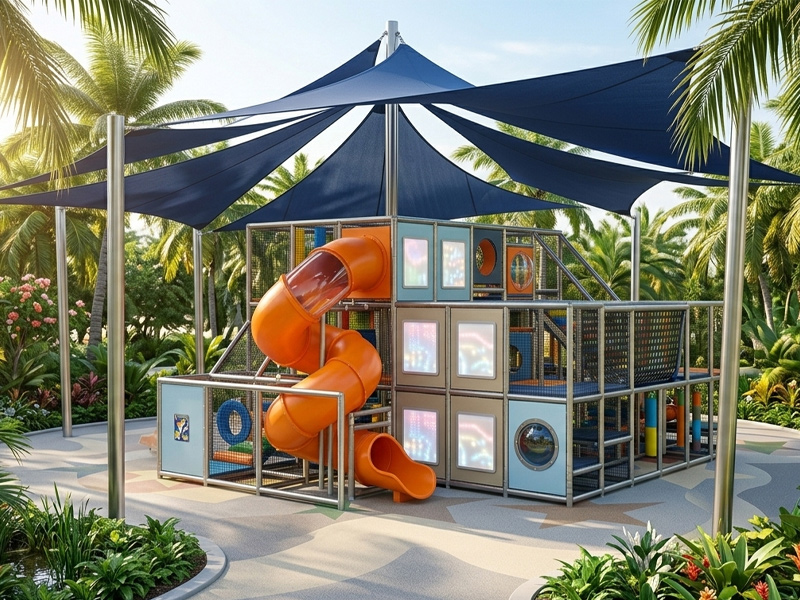
- Tensile membrane structure (Sail Shades): Made of breathable high-density polyethylene fabric, it can block more than 95% of ultraviolet rays and promote air convection by utilizing the principle of hot air rising, thus reducing the perceived temperature under the shade.
- Landscape vegetation: Strategically planting broad-leaved trees can not only provide natural shade, but also regulate local humidity and temperature through transpiration.
Coping with humid and tropical rainy climates
In areas with high humidity and frequent rainfall, such as the southeastern coast or tropical rainforests, corrosion prevention, slip prevention, and drainage engineering are of paramount importance.
Drainage system and foundation engineering
Water accumulation is a major cause of accelerated corrosion and mold growth on amusement equipment. During the site planning phase, it is essential to ensure that the foundation surface has a slope of 1% to 4% to allow rainwater to drain quickly into sewers or rain gardens.
For flooring systems, highly permeable materials or underground drainage layers should be prioritized. Furthermore, reinforced drainage points should be installed in areas with high frequency of contact with the ground, such as slide exits and the bottom of steps, to prevent moisture from accumulating at joints and causing the metal base to rot.
Advantages of composite materials and synthetic wood
While natural red cedar and redwood possess inherent resistance to decay, they still require frequent sealing in consistently humid environments. In contrast, wood-plastic composites (WPC) or fully synthetic recycled plastic lumber perform better. These materials do not absorb water, do not rot, do not attract termites, and typically have non-slip textured surfaces, greatly improving safety in rainy weather.
Special engineering projects in cold and high-latitude regions
In regions experiencing prolonged harsh winters and repeated freeze-thaw cycles, the equipment’s resistance to cold and the stability of the foundation are key challenges.
Frost heave and anchorage depth
Frost heave is a common problem in northern playgrounds. The upward thrust generated by the expansion of water in the soil as it freezes is enough to push shallowly buried concrete foundations out of the ground, causing equipment to tilt or even collapse. The solution is to consult local meteorological data to determine the frost line for the area and anchor all support columns below the frost line.
Material adaptability in extremely cold environments
- Flexible rubber: Rubber is an excellent low-temperature material that can maintain its impact absorption properties (fall protection) in sub-zero environments, unlike some plastics that lose their cushioning effect when frozen.
- Cold-resistant slides: High-impact HDPE produced using rotational molding should be selected. This process eliminates internal stress in the material and reduces the risk of brittleness at low temperatures.
- Lubrication and sealing: Low-temperature resistant grease should be used for moving parts such as bearings and chains to prevent condensation from entering and freezing, which could cause the mechanism to lock up.
Ultimate defense against coastal salt spray environment
Coastal environments are widely recognized as having the fastest equipment degradation. Salt spray, as a strong electrolyte, attacks the passivation film on metal surfaces.
材质与涂层的高级配置
In addition to the 316 stainless steel mentioned above, aluminum alloy components in coastal areas should undergo marine-grade anodizing. For coatings, a three-layer protective system is recommended:
- Base coat: Zinc-Rich Primer, providing the first sacrificial line of defense.
- Middle layer: Epoxy mid-coat, creating a highly dense moisture barrier layer.
- Topcoat: Polyurethane, providing excellent UV protection and gloss retention.
Regional differences in warranty terms
Professional purchasing personnel should note that most commercial amusement equipment manufacturers’ warranty agreements have specific restrictions for coastal areas. Typically, if the equipment is installed within 457 meters (500 yards) of the coastline, the standard warranty period will be reduced by half, or cosmetic defects caused by corrosion will be excluded altogether. Some manufacturers require mandatory freshwater flushing every quarter, and records must be kept; otherwise, the warranty will expire.
Safety standards and compliance(ASTM F1487 & EN 1176)
Regardless of the climate, amusement rides must meet strict safety performance specifications.
Structural safety and drop protection
ASTM F1487 is the most authoritative commercial amusement equipment standard in North America. It specifies the dynamic and static load requirements of the equipment, as well as the opening size to prevent head entanglement and limb sinking (special attention should be paid to gaps such as 3/8 inch to 1 inch).
The size of use zones is also affected by climate. In windy areas, the swing path of a swing may be deflected by wind, so it is recommended to increase the buffer area by 10% from the standard. The critical fall height of the pavement must be verified in the field regularly using portable testing instruments (such as Triax), especially after extreme freeze-thaw cycles, as the energy absorption efficiency of the ground may decrease significantly due to changes in the physical properties of the materials.
Environmental durability testing procedures
To verify the performance of devices under specific climate conditions, manufacturers typically conduct the following accelerated laboratory tests:
- Salt spray test (ASTM B117): Coated samples are subjected to continuous salt spray for thousands of hours in a sealed chamber to observe peeling, blistering or corrosion.
- Ultraviolet aging test (ASTM G154/G155): Simulates high-intensity sunlight and condensation cycles to evaluate the material’s grayscale and mechanical retention.
Maintenance, inspection and full lifecycle management
A preventative maintenance plan tailored to specific climate conditions can extend equipment lifespan by more than 30%.
Seasonal inspection checklist
| season | Maintain core matters | Key operating steps |
| Spring (thawing period) | Structural stability and drainage | Check if the foundation has shifted due to frost heave; clear snow and debris from the drainage outlets; inspect plastic parts that have cracked due to icing. |
| Summer (high frequency period) | Surface heat and ultraviolet radiation | Measure the surface temperature of the slide; check the tension of the sunshade sail and the wind-resistant ropes; kill wasps or pests inside the equipment. |
| Autumn (Preparation Period) | Corrosion protection and plant pruning | Repair powder coating scratches; trim nearby trees to reduce acid corrosion from fallen leaves; check the tightening torque of connectors. |
| Winter (protection period) | Brittleness prevention and de-icing safety | Disassemble and store the swing seats and sunshade sails; the use of corrosive industrial salt for de-icing is strictly prohibited (granular sand or non-corrosive de-icing agents should be used). |
The Importance of Digital Maintenance Records
According to Google’s E-E-A-T standard, professional amusement park operators should establish comprehensive digital maintenance logs. These logs should record the time, content, problems found, and repair results of each inspection. This is not only necessary for legal liability reduction but also allows for the discovery of degradation patterns of specific materials under specific microclimates through data accumulation, providing a scientific basis for future procurement.
Conclusions and professional recommendations
The performance of outdoor playground equipment under different climate conditions is the result of a trade-off between engineering choices and the natural environment. To create a safe, durable, and cost-effective play space, decision-makers should adhere to the following core principles:
First, a detailed site microclimate assessment must be conducted during the planning phase to identify key degradation drivers (such as extremely high UV radiation, high humidity, or extreme cold). Second, the initial purchase price should not be the sole determining factor; maintenance frequency and expected replacement cycles should be considered holistically. For example, while the CAPEX of using 316 stainless steel and recycled plastics in coastal areas may be higher, the life-cycle cost (LCC) is significantly lower than that of plain carbon steel equipment requiring frequent maintenance and replacement.
Finally, establish a routine, professional inspection system tailored to seasonal climate characteristics, and ensure that all maintenance operations comply with the latest ASTM and EN standards. Through this comprehensive technical management, playgrounds can truly overcome climate limitations and become safe havens for children’s healthy growth.
FAQ
Q: Why do our plastic slides start to fade and become brittle three years after installation?
A: This is usually due to insufficient UV rating of the selected material, or because of extremely high local UV intensity and a lack of shading facilities. Photodegradation breaks down molecular chains, leading to a loss of the material’s mechanical properties. In areas with strong sunlight, it is recommended to choose HDPE materials with a UV rating of 20 or higher.
Q: In snowy areas, which flooring material is the safest?
A: Pour-in rubber flooring (PIP) and rubber tiles are better choices because they remain elastic at low temperatures. In contrast, wood fiber or sand becomes very hard after freezing, losing its impact absorption capacity and greatly increasing the risk of head injuries.
Q: Can aluminum alloy equipment be installed in coastal amusement parks?
A: Yes, but it must be confirmed that the aluminum alloy has undergone high-quality powder coating or anodizing treatment. While aluminum won’t rust like steel, it can experience pitting corrosion, also known as “white rust.” The key is that all connections (bolts, nuts) must be made of 316 stainless steel to prevent galvanic corrosion.
Q: How do I determine if a coating needs repair?
A: If blistering, peeling, or exposure of the metal substrate is observed in the coating, it must be sanded and repainted immediately. Any tiny gap can become the starting point for an electrochemical reaction in a humid environment, leading to the spread of “undercoating corrosion.”


