
Currently Empty: $ 0.00
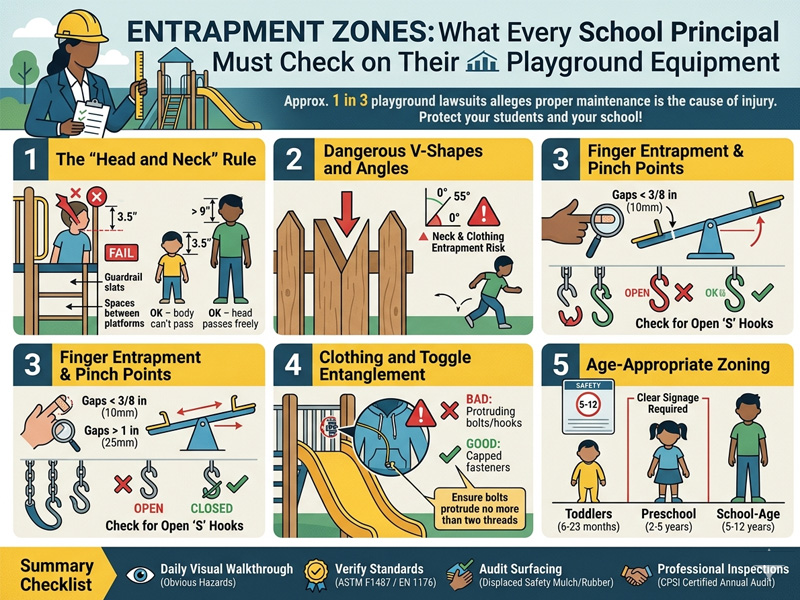
As a school principal, the playground is often the heart of your students’ social and physical development. However, it can also be a significant source of liability. Statistics indicate that approximately one out of every three playground-related lawsuits alleges a lack of proper maintenance as the primary cause of injury. Among the most critical—yet often overlooked—safety risks are entrapment zones.
Entrapment occurs when a child’s body part becomes caught in an opening from which they cannot easily escape, potentially leading to falls, broken bones, or in extreme cases, strangulation. To ensure your school remains a safe environment, here are the non-negotiable entrapment checks every administrator must understand.
1. The “Head and Neck” Rule: The 3.5 to 9-Inch Gap
The most dangerous form of entrapment is head and neck entrapment. This happens when a child’s body can pass through an opening, but their head cannot.
- The Standard: Both North American (ASTM F1487) and European (EN 1176) standards agree on the “Goldilocks” measurements for bounded openings. To be safe, any gap must be smaller than 3.5 inches (89 mm) to prevent the body from entering, or larger than 9 inches (230 mm) to allow the head to pass through freely.
- Where to Check: Pay close attention to guardrail slats, ladder rungs, and the spaces between platforms.
2. Dangerous V-Shapes and Angles
Partially bounded openings, specifically V-shaped gaps where the “V” points downward, are high-risk areas for neck entrapment.
- The Risk: If a child’s neck slides into the narrow point of a V-shape (such as at the top of a fence or where two structural members meet), they may not have the motor skills or strength to lift themselves out.
- The Checklist: Look for any angles between 0 °and 55° on elevated structures. These are notorious for catching not just limbs, but also clothing drawstrings and hood cords.
3. Finger Entrapment and Pinch Points
While less life-threatening than head entrapment, finger injuries are frequent and painful.
- The Measurement: Gaps in moving equipment (like spinners, seesaws, or swing chains) should be less than 3/8 inch (10 mm) or greater than 1 inch (25 mm).
- Specific Hazard: Check for open “S” hooks on swings. An open “S” hook is a double threat: it can pinch a finger and catch a child’s clothing, leading to entanglement.
4. Clothing and Toggle Entanglement
Modern safety standards emphasize “clothing entanglement” hazards, particularly near the entry points of slides.
- The Hazard: Protruding bolts, loose nuts, or hardware that forms a hook can catch drawstrings, scarves, or jewelry.
- The Test: Ensure that no bolt ends protrude more than two threads beyond the face of the nut. All fasteners should ideally be capped.
5. Age-Appropriate Zoning
Principals must ensure that children are using equipment designed for their developmental stage. ASTM standards divide equipment into three main groups: Toddlers (6–23 months), Preschool (ages 2–5), and School-Age (5–12 years).
A gap that is safe for a 10-year-old might be a perfect entrapment zone for a 3-year-old. Ensure your playground has clear signage indicating the intended age group for each structure.
Summary Checklist for Principals
- Daily Visual Walkthrough: Have staff look for obvious hazards like broken parts, loose bolts, or debris.
- Verify Standards: Ensure your equipment provider complies with ASTM F1487 (US/Canada) or EN 1176 (Europe/UK).
- Audit Surfacing: Entrapment risks are exacerbated if safety surfacing is displaced, changing the fall height and distance to the structure.
- Professional Inspections: Schedule an annual audit by a Certified Playground Safety Inspector (CPSI) to catch technical violations that the naked eye might miss.


