
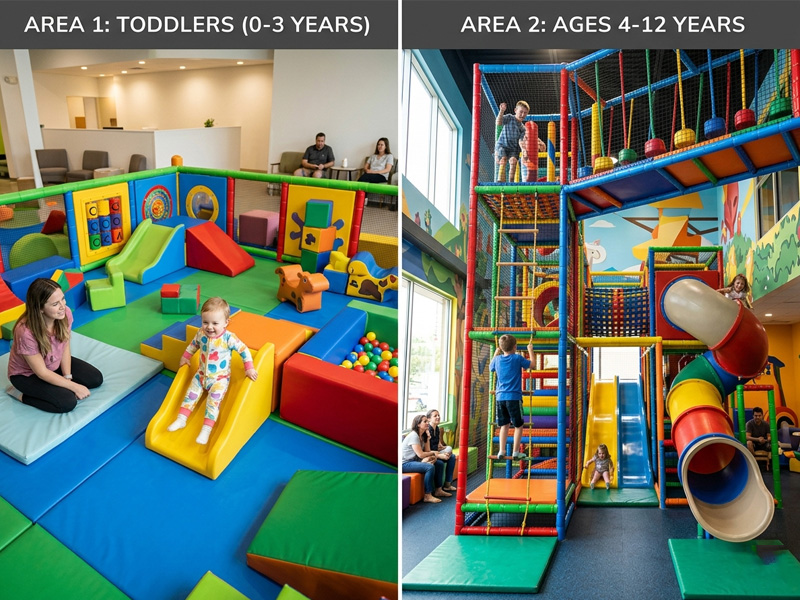
Devices Suitable for Each Age Group
When designing an indoor playground, equipment selection should be tailored to the specific age characteristics of the children. Ages 0–2 (Infants and Toddlers): Activities at this stage primarily take place on the floor or within low-level crawling structures; therefore, equipment such as soft climbing frames, low-profile slides, sensory play stations, and ball pits should be utilized. All surfaces must be thoroughly padded with cushioning materials to prevent injury from falls. Ages 2–4 (Toddlers): Toddlers possess strong curiosity and improved physical mobility; suitable equipment choices include slightly taller small-scale climbing nets, enclosed slides, tunnels, and soft building block sets. These structures should feature soft edges and low heights to ensure the children feel secure. Ages 4–6 (Preschoolers): The playground can be enhanced with a diverse array of play elements, such as longer slides, multi-component climbing structures, and role-playing playhouses. Equipment for this age group should emphasize interactivity—for instance, through features like simulated shops or maze-like corridors. Ages 6–12 (School-Aged Children): As children’s physical strength and coordination continue to develop, the design can incorporate more challenging elements such as climbing walls, obstacle courses, multi-level play structures, and throwing games. While the height and range of motion of the equipment may increase, it is essential to simultaneously install thicker protective padding. Ages 12 and Up (Adolescents): At this stage, the facility can introduce trampoline zones, bouncing apparatuses, interactive riding equipment, or simple fitness stations. For example, an indoor trampoline park is well-suited for both adolescents and adults, offering a variety of activities including free-jumping areas, foam pits, dodgeball courts, and bungee trampolines.
| Age Group | Sample Device | Security Considerations |
|---|---|---|
| 0–2years old | Soft Play Structure, Low Slide, Sensory Play Station, Ball Pit | The equipment features an extremely low profile, with all surfaces fully soft-padded and free of sharp edges; the floor is entirely covered with thickened cushioning mats. |
| 2–4years old | Small Climbing Net, Fenced Slide, Tunnel, and Soft Block Set | The walls and railings are sufficiently high to prevent falls; the mesh openings are sized to prevent entrapment injuries; and soft cushioning material covers the entire landing area. |
| 4–6years old | Medium-sized climbing frame, combination slide, small swing, role-play house | The equipment is spaced appropriately to prevent collisions; guardrails are installed at the top of the slide; and prior to use, the equipment must be ensured to be completely stable and secure. |
| 6–12years old | Multi-level Climbing Structure, Mini Swinging Bridge, Bouncing Balls, Basketball Shooting Zone | Constructed using heavy-duty structural components compliant with ASTM/EN standards; the fall zone is equipped with thick safety mats; dynamic load-bearing calculations are applied. |
| Ages 12 and up | Indoor Trampolines, Obstacle Training Zone, Climbing Wall | Install safety netting around the trampoline; utilize handholds for secure climbing; regularly inspect springs and jumping mats; and obtain certification and insurance approval prior to installation. |
Safety Standards and Regulations
Indoor playground equipment must comply with multiple international safety standards, primarily including ASTM F1918-12, ASTM F1487, EN 1176-1 through 11, and EN 1177. Notably, ASTM F1918-12 is the world’s first safety performance specification specifically developed for indoor soft-contained play equipment; the EN 1176 standards (comprising multiple parts) and EN 1177 establish design requirements for playground equipment and impact-absorbing surfaces. Various countries may also adopt additional standards, such as CSA Z614 (Canada) and AS 3533.4 (Australia).
Fall Protection: The maximum fall height for all playground equipment must be clearly marked, and the fall zones must be surfaced with shock-absorbing mats that comply with the requirements of ASTM F1292 or EN 1177. It is generally recommended to install impact-absorbing mats with a minimum width of 1.5 meters around the perimeter of the equipment—and a minimum thickness of 6 to 12 inches—to cushion the impact should a child fall.
Pinch Protection and Clearance: The spacing of netting, openings, and railings must comply with standard requirements to prevent young children’s heads or limbs from becoming entrapped. EN standards stipulate that horizontal or vertical gaps should be either less than 3.5 inches or greater than 9 inches; this serves to eliminate the risk of head entrapment while simultaneously preventing accidental falls. Furthermore, the dimensions of components such as handrails and ladder rungs should be appropriately sized for children to grasp.
Structural Stability: The equipment frame must be constructed from durable steel or heavy-duty plastic, capable of meeting load-bearing requirements and securely fastened in place. Connection points require reinforcement, and all edges must be rounded and padded with soft protective materials to prevent scratches. Materials used should be flame-retardant, non-toxic, and odorless—for instance, by utilizing flame-retardant coatings that comply with standards such as UL94, NFPA 701, or EN 13501-1.
Certification and Testing: Compliance requires verification through third-party testing and certification (e.g., TUV, SGS). Audits against relevant standards should be conducted starting from the design phase, followed by professional inspections upon installation. Operating entities must retain documentation—including design specifications, test results, and inspection reports—to facilitate regulatory reviews and insurance audits.
Material Selection
Common safety materials used in indoor playground equipment include soft foam (used to wrap railings, supports, and flooring), high-density plastic (for the shells of slides, tunnels, etc.), and weather-resistant, fire-retardant steel (for the main structural framework). All plastic and foam products must be non-toxic—complying, for instance, with REACH, CPSIA, or EN 71 standards—and must be free of heavy metals such as lead. The use of flame-retardant materials is critical; they must meet standards such as UL94 V-0, NFPA 701, or EN 13501-1 to prevent the spread of fire. Surface coatings should be antimicrobial and easy to clean; modern playgrounds increasingly advocate for the application of antimicrobial coatings or materials on high-touch surfaces to minimize the transmission of infectious diseases. Flooring typically consists of rubber safety mats or closed-cell foam carpeting, which are soft, durable, effective at absorbing impact, and compliant with accessibility requirements.
Design Suggestions
An excellent indoor playground design must adhere to the principles of providing unobstructed sightlines and ensuring monitorable safety. When planning the layout, it is essential to maintain sufficient spacing between distinct play zones to facilitate continuous supervision of children’s activities by parents and staff. Visibility should be enhanced through the use of vibrant, contrasting colors and clear signage, while simultaneously eliminating any blind spots. Play areas designated for different age groups should be physically separated—for instance, by utilizing fences or netting to partition the toddler zone from the area for older children—thereby mitigating the safety risks associated with children of varying heights playing together. To stimulate multi-sensory development, the design should incorporate tactile, auditory, and visual elements—such as play equipment featuring interactive music, illuminated panels, or touch-sensitive walls (Note: Multi-sensory design is particularly beneficial for fostering the development of children with diverse abilities).
Accessibility is also a crucial consideration: entrance walkways and circulation paths within various zones must be sufficiently wide to accommodate wheelchair access. Wherever possible, incorporate ground-level (non-stepped) interactive elements—such as activity panels or soft-foam sculptures—into each functional area to ensure participation is accessible to children with mobility impairments as well as those in strollers. Install ramps or handrails at elevated points, such as on play towers or at the tops of slides, to ensure access for children of all abilities. It is equally important to provide designated rest or quiet zones, allowing children who require a respite or a change in sensory stimulation to temporarily withdraw from the bustling areas and calm down.
Maintenance and Cleaning
Maintaining the cleanliness of equipment and the premises is a fundamental requirement for safe operations. All surfaces—particularly high-contact areas such as slides, climbing structures, and ball pits—should be cleaned and disinfected daily. In the event of incidents involving vomiting, bleeding, or similar occurrences, the affected area must be immediately cordoned off and subjected to thorough cleaning and disinfection. Equipment safety inspections should be conducted daily, both before opening and after closing; these inspections should check for any damaged, loose, or worn components, ensuring that all screws and nuts are securely fastened and that connection points are free of sharp edges or hazards that could cause scratches. Insurance policies typically mandate an annual third-party audit, wherein a professional inspection agency verifies structural stability and surface integrity, subsequently issuing a formal report. It is recommended to establish a digital record-keeping system to facilitate the real-time tracking of maintenance logs and material replacement history.
Accessibility and Inclusive Design
Modern playgrounds should be designed to allow children of varying abilities to participate safely. In addition to the aforementioned wide pathways and level activity areas, the needs of children with visual or hearing impairments must also be taken into account: this entails providing tactile signage, creating zones with high visual contrast, and incorporating interactive auditory elements. The layout of the space should also consider individuals with sensory sensitivities—for instance, by establishing soundproof or low-stimulation “quiet corners” and avoiding conditions that are overly crowded or noisy. All instructional signage should be presented in a format that combines both text and graphics; furthermore, where necessary, low-mounted handholds and railings should be installed to ensure accessibility for children of different heights or those who rely on assistive devices. In essence, the core design philosophy of an inclusive playground is to ensure that every child can “participate rather than be excluded.”
Commercial vs. Residential Equipment Comparison
Commercial indoor playground equipment differs significantly from residential equipment in terms of scale, safety, and durability. Commercial equipment typically occupies a larger area, accommodates a greater number of children, and features more robust structural materials (such as thickened steel tubing and reinforced plastic components). It must undergo rigorous commercial safety certification, utilize wear-resistant and fire-retardant commercial-grade materials, and undergo frequent inspection and maintenance. Commercial playgrounds also require professional installation services and appropriate insurance coverage. Residential equipment, conversely, is smaller in scale and lower in cost; it typically employs thinner steel tubing or plastic components and is easily installed in backyards or indoor spaces. However, its materials offer lower durability and impact resistance, making it suitable only for limited, private family use. Furthermore, commercial playground designs and themes are far more diverse and can be customized to meet specific client requirements, whereas residential equipment options are more limited, with designs tending to focus on single-functionality.
Frequently Asked Questions
Q:What safety standards must indoor playground equipment comply with?
A:Depending on the specific location, international standards such as ASTM (e.g., F1918, F1292) and EN (1176/1177) should be adhered to. These standards stipulate specific requirements regarding equipment structure, materials, impact-absorbing surfacing, guardrail heights, and net and rope spacing. For instance, ASTM F1918 is specifically designed for soft indoor playground equipment, while EN 1176 provides detailed regulations concerning equipment spacing and the prevention of entrapment injuries.
Q:How to Choose Suitable Indoor Playground Equipment for Children of Different Ages?
A:Equipment should be selected based on a child’s age and developmental stage: low-level, soft play structures are suitable for children aged 0–2; small climbing nets and tunnels for those aged 2–4; multi-functional climbing frames and slides for ages 4–6; and for children over 6, more challenging climbing walls or trampolines may be introduced. Ensure that the dimensions, colors, and materials of all equipment are appropriately matched to the children’s height and motor skills.
Q:What kind of cushioning protection is required for indoor playground flooring??
A:Ground surfaces in all potential fall zones must be covered with impact-absorbing materials—such as 12-inch-thick rubber mats, foam mats, or wood chips. These materials must meet the standards of ASTM F1292 or EN 1177 to ensure they effectively absorb impact forces in the event of a child falling. Under no circumstances may hard surfaces (such as concrete or tiles) serve as the primary flooring within the main play area.。
Q:What is the difference between indoor playgrounds and home playground equipment??
A:Commercial playground equipment is larger in scale and constructed from sturdier materials, requiring compliance with more rigorous safety certifications. For instance, commercial-grade equipment utilizes thick steel tubing and commercial-grade plastics, offering superior load-bearing capacity and durability; conversely, residential equipment is typically smaller in size and constructed from lighter, thinner materials, making it suitable only for use by a small number of family members. Furthermore, commercial equipment is generally professionally designed and installed—often including year-round maintenance services—whereas residential equipment is typically purchased through retail channels or assembled via DIY methods.
Q:How to Maintain and Inspect Indoor Playground Equipment?
A:Equipment inspections should be conducted daily, both before opening and after closing: check for loose screws, surface cracks, worn netting or ropes, uneven floor mats, and similar issues. Additionally, all surfaces must be cleaned and disinfected daily—or multiple times a day. Annually, a third-party expert must be engaged to conduct a safety audit, verifying structural integrity and the effectiveness of all safety features. Maintain detailed records of all inspections and maintenance activities to ensure compliance with regulatory and insurance requirements.


