
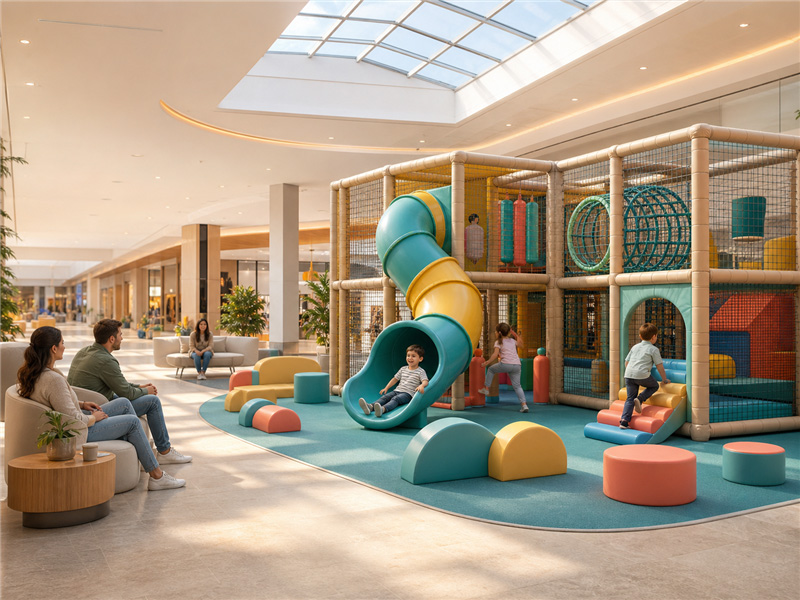
Why Safety Should Be the First Priority for Mall Indoor Playgrounds
An indoor playground in a shopping mall serves a large and diverse audience. Children may visit during busy weekends, holidays, and special events, often with parents who are shopping, dining, or waiting nearby. Unlike a small private playroom, a mall indoor play area must withstand frequent use while reducing foreseeable risks.
Safe equipment protects children from falls, entrapment hazards, sharp edges, unstable structures, and collisions. It also helps mall owners reduce liability exposure, avoid costly repairs, and build trust with families.
When evaluating commercial indoor playground equipment in the USA, do not focus only on the initial price. A lower-cost product can become expensive if it requires frequent repairs, lacks documentation, uses poor-quality materials, or fails local inspection requirements. Safety, durability, and compliance should be treated as core purchasing criteria from the beginning.
1. Choose Equipment Designed for Commercial Use
One of the biggest mistakes buyers make is purchasing residential play equipment for a public mall environment. Home-use playground products are not built for the same traffic level, supervision conditions, or operational demands as commercial installations.
Commercial indoor playground equipment should be engineered for frequent use by many children every day. Look for structures with reinforced frames, durable connectors, protected fasteners, impact-resistant components, and high-quality padding.
A reliable supplier should clearly state that the product is intended for public or commercial use. Ask for information about:
- Recommended age range
- Maximum occupancy
- Weight limits
- Structural materials
- Safety certifications or test reports
- Installation requirements
- Maintenance instructions
- Warranty coverage
For most shopping malls, soft contained play equipment is a popular choice because it combines climbing, crawling, sliding, and interactive features within a padded, enclosed environment. It can be customized for different floor plans and is often easier to integrate into a mall’s branding or seasonal theme.
2. Understand Relevant U.S. Safety Standards
Before purchasing safe indoor playground equipment for shopping malls, ask the supplier which recognized safety standards apply to the system. In the United States, public playground safety is often guided by recommendations from the U.S. Consumer Product Safety Commission and relevant industry consensus standards.
For indoor soft play structures, ASTM F1918 is commonly associated with safety performance for soft contained play equipment. Other standards may apply depending on the equipment type, surfacing, accessibility features, and local project requirements.
Important point: safety standards, building codes, fire regulations, and local permit requirements can vary by city, county, and state. Do not assume that a supplier’s general certificate automatically guarantees approval for your specific mall location.
Before finalizing the purchase, coordinate with:
- Your mall’s property management team
- Local building and fire authorities
- A qualified playground inspector or safety consultant
- The equipment manufacturer or installer
- Your insurance provider, when appropriate
This early review can prevent design changes, delayed openings, or unexpected compliance costs later.
3. Select Age-Appropriate Play Features
A successful mall indoor playground should serve its intended users safely. Mixing toddlers and older children in the same active play zone can increase the chance of collisions and injuries.
The best approach is to divide the playground into clear age-appropriate areas. For example, a toddler zone may include low platforms, soft ramps, sensory panels, mini slides, foam blocks, and crawl tunnels. A zone for older children may include climbing nets, tube slides, rope obstacles, interactive games, bridges, and more challenging climbing elements.
Clear signage should identify the intended age group for each zone. Visual rules are especially useful in malls because visitors may speak different languages or may not read detailed instructions.
When planning a mall indoor play area, consider the following age groups:
- Toddlers: approximately 1–3 years old
- Preschool children: approximately 3–5 years old
- School-age children: approximately 5–12 years old
The exact age range should match the manufacturer’s recommendations and your final operating policy. Avoid adding high-speed or high-climb elements in areas mainly intended for very young children.
4. Prioritize Soft, Durable, and Easy-to-Clean Materials
Indoor playground equipment must be safe, but it must also remain clean and attractive after thousands of visits. Shopping malls experience high foot traffic, and play areas can quickly collect dust, food residue, germs, and wear marks.
Choose materials that are durable, non-toxic, easy to sanitize, and resistant to daily use. Common quality features include:
- Soft foam padding with durable PVC or vinyl covers
- Enclosed steel frames with protective coatings
- Rounded plastic components without sharp edges
- Netting designed for commercial play structures
- Anti-slip flooring in entry and exit areas
- Easy-to-clean surfaces and removable protective pads
Ask whether the materials are free from harmful substances and whether the supplier provides cleaning recommendations. Mall operators should create a written cleaning schedule that includes daily wipe-downs, regular deep cleaning, and immediate cleaning after spills or accidents.
A clean indoor playground is not only a hygiene issue. It also affects customer perception. Parents are far more likely to trust and revisit a play area that looks well maintained.
5. Plan the Layout for Visibility and Supervision
A beautiful playground can still be unsafe if parents or staff cannot easily see what is happening inside. Good visibility is one of the most important design factors for shopping mall playgrounds.
Avoid layouts with too many hidden corners, blocked sightlines, or enclosed spaces that are difficult to monitor. Parents should be able to see their children from nearby seating areas whenever possible. If staff supervision is part of your operating model, provide a clear viewing point for employees.
A well-planned layout should include:
- A visible entrance and exit
- Controlled access points
- Seating for parents and caregivers
- Clear sightlines into active play zones
- Adequate pathways around the structure
- Emergency access for staff
- Space for strollers, shoes, and personal belongings
- Clearly displayed rules and contact information
The location inside the mall matters, too. A family zone near restaurants, children’s retailers, cinemas, or waiting areas can increase foot traffic. However, avoid placing the playground too close to escalators, busy entrances, open balconies, or high-traffic corridors unless proper barriers and circulation planning are in place.
6. Check Flooring and Fall Protection Carefully
Children fall during play. The goal is not to eliminate all movement and challenge, but to reduce the severity of injuries when falls happen.
Flooring is therefore a critical part of safe indoor playground equipment for shopping malls. The surface under and around active play elements should be appropriate for the equipment and its intended use. Hard flooring such as tile, concrete, or untreated wood should not be exposed in areas where children may fall.
Depending on the project, suitable solutions may include padded flooring, foam mats, rubber-based safety surfacing, or other impact-attenuating materials. The flooring system should be installed correctly, secured at the edges, and maintained without tears, gaps, loose seams, or uneven sections.
Do not treat flooring as an afterthought. Include it in the original project budget and ask the supplier to specify recommended surfacing for every play zone.
7. Include Accessibility in the Design
Accessibility is both a legal consideration and a better customer experience. Families want inclusive spaces where children of different abilities can participate together.
The ADA Standards for Accessible Design include provisions relevant to play areas, including accessible routes and requirements for soft contained play structures in applicable settings. The exact obligations depend on the facility and project, so consult a qualified accessibility professional for your location.
In practical terms, inclusive design may include:
- Accessible routes to the play area
- Accessible entry points into soft contained play structures
- Ground-level activities for children with different mobility levels
- Sensory panels, music activities, and tactile games
- Wide circulation paths for wheelchairs and strollers
- Seating options for caregivers
- Clear signs with easy-to-understand visual instructions
Inclusive features should not be placed in an isolated corner. When possible, integrate them into the main play experience so children can play alongside one another.
8. Evaluate Fire Safety and Building Requirements
Shopping malls have strict building operations, and indoor playground installations may affect fire safety planning, emergency access, sprinkler coverage, occupancy calculations, and exit routes.
Before approving a playground design, confirm that it does not obstruct:
- Fire exits
- Emergency walkways
- Sprinkler systems
- Smoke detectors
- Electrical panels
- Required clearances
- Accessibility routes
Some indoor play structures may require special review because of their size, enclosure design, ceiling height, or proximity to fire protection systems. Your landlord, architect, contractor, and local authorities should review the final drawings before installation begins.
A responsible indoor playground supplier should be willing to provide layout drawings, dimensions, material details, and installation documents needed for project review.
9. Ask About Installation, Inspection, and Maintenance
The safest equipment can become unsafe if it is installed poorly or neglected after opening. Professional installation is essential, particularly for larger commercial indoor playground equipment.
Ask the supplier whether installation is included and who is responsible for final inspection. You should also receive a maintenance manual that explains how to inspect the equipment regularly.
A practical maintenance plan should include:
- Daily visual checks for loose parts, damaged padding, spills, or debris
- Weekly checks of netting, connectors, fasteners, and floor seams
- Monthly detailed inspections of structural components
- Immediate removal or repair of damaged elements
- Documentation of inspections, cleaning, and repairs
Staff should know what to do if they find torn netting, exposed foam, loose bolts, damaged slides, or an unsafe floor surface. Keep records of all maintenance activities. These records help demonstrate responsible operation and make it easier to track recurring issues.
10. Choose a Supplier With Real Commercial Experience
Your supplier is not simply a product vendor. They should be a project partner who understands public play environments, mall requirements, safety documentation, and installation logistics.
When comparing suppliers of safe indoor playground equipment for shopping malls, ask for:
- Previous mall or family entertainment center projects
- Product drawings and 3D design proposals
- Safety documentation
- Material specifications
- Installation timeline
- Warranty details
- Spare parts availability
- Maintenance guidance
- Customer references or case studies
Be cautious of suppliers who promise a custom design without first asking about your floor plan, ceiling height, target age group, mall rules, or budget. A professional supplier will ask detailed questions before recommending a solution.
The cheapest quote is rarely the best value. Consider the full lifecycle cost, including shipping, installation, flooring, repairs, cleaning, replacement parts, insurance considerations, and future expansion.
Frequently Asked Questions
What is the best indoor playground equipment for a shopping mall?
The best option depends on your available space, target age group, budget, and business model. Soft contained play structures are often ideal for malls because they are visually attractive, flexible, padded, and suitable for multiple activity types. A combination of climbing features, slides, sensory panels, toddler activities, and parent seating usually creates the strongest experience.
Is commercial indoor playground equipment required for mall installations?
For a public mall setting, commercial-grade equipment is strongly recommended. It is designed for higher traffic, repeated use, and public safety expectations. Residential equipment is generally not suitable for the demands of a busy mall environment.
How much space does a mall indoor playground need?
A small play area may fit into a compact retail unit or open common-area zone, while larger installations can occupy thousands of square feet. The right size depends on expected visitor volume, local requirements, available supervision, and the types of activities you plan to offer.
How can malls keep indoor playgrounds clean?
Malls should establish a daily cleaning routine, clean spills immediately, inspect high-touch surfaces regularly, and schedule deep cleaning. Choosing smooth, durable, easy-to-sanitize materials makes maintenance more efficient.
What should I check before ordering indoor playground equipment?
Confirm the floor plan, ceiling height, age group, accessibility needs, safety documentation, local permit requirements, installation responsibilities, maintenance plan, and warranty. Reviewing these details before ordering can save significant time and money.
Final Thoughts
Choosing safe indoor playground equipment for shopping malls in the USA is an investment in both family experience and long-term business value. The right playground can turn an ordinary mall visit into a memorable outing, encouraging families to stay longer and return more often.
Focus on commercial-grade construction, age-appropriate design, reliable fall protection, accessible features, visible supervision, easy-to-clean materials, and a supplier with proven experience. Most importantly, review local building, fire, accessibility, and operational requirements before installation.
A safe, well-designed mall indoor play area does more than entertain children. It helps create a destination that families trust, enjoy, and want to visit again.


