
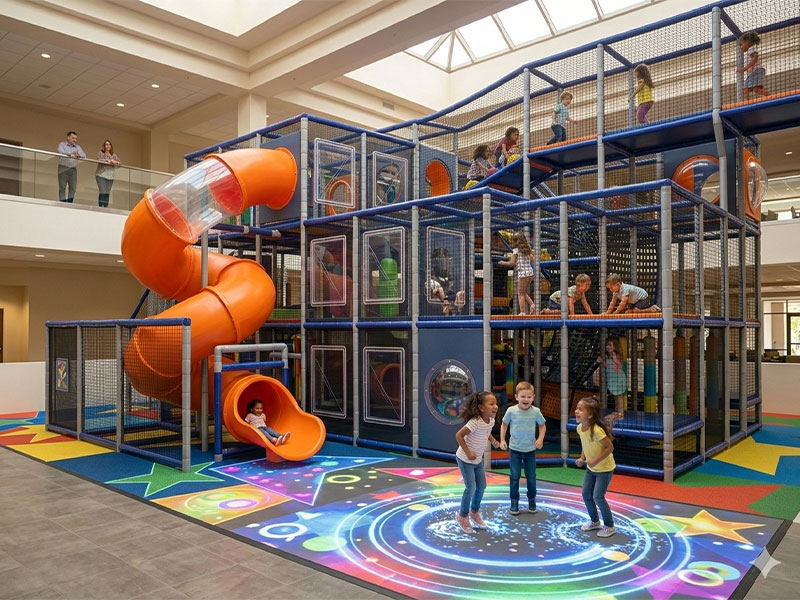
The concept of the indoor playground has undergone a radical transformation since its inception in the late 20th century. Originally designed as rudimentary padded areas in shopping malls or community centers to provide a weather-proof environment for children, these spaces have evolved into highly sophisticated Family Entertainment Centers (FECs) that anchor multi-billion dollar commercial developments. In 2026, an indoor playground is defined as a purpose-built enclosure that allows children to engage in physical and imaginative play within a safe, climate-controlled, and supervised setting. As the global FEC market is projected to exceed $40 billion by the end of 2025, the “modern playground” now functions as a complex ecosystem where high-precision engineering, digital gamification, and strategic business modeling converge to foster child development while maximizing commercial return on investment (ROI).
Understanding how an indoor playground works requires looking beyond the vibrant colors and soft padding. At its core, it is a system of integrated zones designed to stimulate specific developmental milestones—ranging from gross motor skills and coordination to social interaction and cognitive problem-solving. These facilities operate year-round, regardless of external weather conditions, making them essential “wellness hubs” for urban communities. By combining physical challenges like multi-story climbing towers and ninja courses with advanced technologies like Augmented Reality (AR) and interactive projection mapping, these venues offer a multi-sensory experience that keeps children engaged for longer periods compared to traditional outdoor parks. This guide explores the physical, mechanical, and operational frameworks that define the modern indoor playground industry.
The Physical Architecture: Components and Materials
The physical structure of a commercial indoor playground is a marvel of modular engineering, typically constructed using high-grade galvanized steel pipes with a standard diameter of 48mm and a wall thickness of 2mm to ensure structural integrity. This framework is then shrouded in multi-layer safety platforms, durable foam padding, and non-toxic, anti-static PVC vinyl covers that are fire-retardant and easy to sanitize. These materials are selected not just for their aesthetic appeal but for their ability to withstand heavy daily use in a high-traffic environment while meeting rigorous international safety standards. A typical high-capacity play structure, often referred to as a “climbing maze” or “soft play arena,” utilizes vertical space to pack multiple levels of activity—such as slides, crawl tunnels, and bridges—into a compact floor footprint.
The components within these structures are strategically chosen to provide diverse play experiences. Standard “anchor features” include spiral slides, ball pits with thousands of anti-crack LLDPE balls, and interactive “spider towers” designed for safe exploration in elevated areas. For older children, adventure play facilities incorporate more challenging elements like rope courses, climbing walls with natural rock textures, and “donut slides” that simulate the exhilaration of snow sliding. Every component is engineered to eliminate hazards such as head entrapment (ensuring openings are smaller than 3.5 inches or larger than 9 inches) and crush points, ensuring a secure environment where children can push their physical limits without risk of serious injury.
| Playground Component | Material/Feature | Primary Developmental Benefit |
| Main Framework | Galvanized Steel (48mm x 2mm) | Structural safety and high-capacity support |
| Protective Covers | 0.55mm PVC Vinyl (Non-toxic) | Impact protection and hygiene maintenance |
| Soft Play Zones | Foam-padded modules | Gross motor skill development for toddlers |
| Slides & Tunnels | LLDPE Plastic & Fiber | Spatial awareness and coordination |
| Flooring | EVA Foam / Poured Rubber | Impact absorption and fall safety |
Mechanical and Digital Integration: How It Works
The “mechanics” of a modern playground often involve sophisticated pneumatic and digital systems that transform static equipment into interactive games. Ball blasters, a staple in many FECs, operate on a fascinating pneumatic principle: an electric motor drives a gearbox that compresses a spring, which in turn moves a piston to compress air in a cylinder. When a child pulls the trigger, this sudden release of pressurized air propels soft foam balls at high speeds through the barrel. These systems are designed to be safe for recreational play, ensuring the velocity is low enough to prevent injury while providing the sensory satisfaction of a “splat” on a target. Advanced “Gladiator” trampolines and motorized merry-go-rounds similarly use self-rotating mechanisms and airflow systems to create dynamic, moving play environments.
Digital integration is the second major mechanical pillar of the 2026 indoor playground. Interactive projection systems—such as motion-sensitive floors and walls—utilize a high-quality projector, infrared (IR) or depth-sensing cameras, and specialized software to create responsive environments. The technical pipeline begins with sensors capturing the child’s movement, which is then processed to extract features like skeletons or “depth blobs.” The software maps these gestures to digital graphics in real-time, often targeting a system latency of under 50-100 ms to ensure smooth, believable interactivity. These systems allow children to pop virtual bubbles, solve AR scavenger hunts, or engage in gamified rock climbing with computerized scoring, blending physical exercise with cognitive challenges and storytelling.
Strategic Design: Zoning, Capacity, and Safety
A successful indoor playground operates on the principle of age-appropriate zoning, which separates children of different developmental stages to prevent accidents and optimize engagement. Best practices recommend dedicated “toddler zones” (ages 0-3) featuring soft blocks, crawl tunnels, and low-height slides that focus on basic crawling and balance skills. In contrast, “main play areas” for school-age children (ages 5-12) utilize taller structures and higher-complexity challenges. This separation is enforced not only through physical barriers but through “clear sightlines” that allow parents and staff to monitor all areas of the playground simultaneously, reducing the need for constant hands-on intervention while maintaining a high safety threshold.
The mathematics of capacity and space allocation is critical for both safety and revenue. The industry standard “Golden Formula” for maximum safe capacity is approximately $ 3 , \text{m}^2/\text{child} $ for the active play area. For a facility to be commercially viable, it often follows the “70/30 Rule,” where 70% of the square footage is dedicated to active play and 30% to ancillary services like cafes, restrooms, and party rooms. This layout ensures high throughput (the number of children playing simultaneously) while providing the “parental comfort” amenities that drive dwell time. Strategic spatial planning can reduce injury rates by up to 30% by distinctly separating high-energy jumping zones from quieter sensory areas, ensuring a harmonious flow even during peak weekend periods.
The Operational Model: Revenue and Maintenance
From an operational standpoint, an indoor playground functions as a multi-layered revenue generator. While ticket sales cover the high fixed costs of rent and labor, the real profit—and the path to an ROI within 12 to 18 months—lies in the “Revenue Triangle”: open play tickets, birthday parties, and Food & Beverage (F&B) sales. Birthday parties are the highest-margin product, often accounting for 35% of total revenue due to pre-booked cash flow and the ability to package premium services. Modern operators also implement “Learning Through Play” programs, such as STEM workshops or career role-play events, to transition the venue from a one-time visit destination into a high-loyalty community hub that encourages repeat memberships.
Maintaining the safety and hygiene of the facility is a non-stop operational requirement. Daily “before opening” inspections are mandatory, covering structural checks (bent frames, loose fasteners) and hygiene protocols (sanitizing high-touch surfaces like handrails and ball pits). Soft play covers must be inspected for tears that might expose foam, which can be a choking hazard if ingested by younger children. Furthermore, facilities must comply with rigorous international codes such as ASTM F1918 in North America and EN 1176 in Europe, which govern everything from flammability (NFPA 701) to the impact-absorption properties of the surfacing. This focus on safety building parental trust is the ultimate driver of long-term success, as families are significantly more likely to return to a facility that is visibly clean, well-maintained, and professionally supervised.
| Operational Metric | Target Benchmark | Strategic Goal |
| EBITDA Margin | 25% to 35% | Healthy operational profitability |
| Rent-to-Revenue | < 18% (Ideally 15%) | Avoid the “Death Trap” of toxic leases |
| Active Play Area | 70% of total floor space | Maximize revenue-generating square footage |
| Dwell Time | 90 to 120 minutes | Increase ancillary spending in cafe/retail |
| Maintenance Reserve | 1% to 2% of gross revenue | Ensure long-term structural safety and hygiene |
Future Trends: Sustainability and Smart Play (2025-2026)
As we look toward the 2026 horizon, two major trends are redefining the industry: sustainability and gamified “Smart Play.” Environmentally conscious families are increasingly seeking “green” venues that utilize recycled and renewable materials—such as reclaimed wood, bamboo, and PVC-free plastics—and energy-efficient LED lighting. These sustainable choices not only reduce the facility’s carbon footprint but also enhance brand trust among modern, eco-aware parents. Concurrently, modular designs are becoming more popular, allowing operators to restructure layouts seasonally without major construction, keeping the experience “fresh” for regular members and reducing long-term waste.
The integration of “Smart Play” involves using RFID wristbands and cloud-based leaderboards to track performance in ninja courses or jump heights in trampoline parks. This gamification turns physical activity into a digital competition, encouraging children to return to beat their personal bests or compete with friends. Furthermore, the industry is seeing a rise in “inclusive design,” where sensory rooms and wheelchair-friendly structures ensure that children of all abilities can play together. By combining these technological advancements with a fundamental commitment to safety and child development, the indoor playground of the future is no longer just a place to burn off energy—it is a sophisticated, inclusive, and high-tech environment for growth and community connection.
Conclusion: The Integrated Success Framework
The modern indoor playground is a complex, multi-functional commercial asset that succeeds through the synthesis of engineering, technology, and strategic operations. From the high-grade galvanized steel that forms its skeleton to the infrared cameras that power its interactive games, every element is designed to work in unison to provide a safe, engaging, and developmentally rich experience for children. By adhering to international safety standards like ASTM F1918 and optimizing the “70/30” spatial layout, investors can create resilient business models that achieve rapid ROI while serving as vital community anchors. As the industry moves toward more sustainable materials and smarter, gamified play systems, the definition of an indoor playground will continue to expand, offering endless possibilities for innovation in child entertainment and development.
Frequently Asked Questions (FAQ)
1. How much space do I need to start a commercial indoor playground?
While the size depends on your business goals, a basic functional play area for toddlers typically starts at 1,000 to 1,500 square feet. For medium to large setups like those in shopping malls or FECs, the space usually ranges from 3,000 to 10,000 square feet, which allows for diversified zones, party rooms, and a cafe area.
2. What is the average cost to build an indoor playground per square meter?
Costs vary based on complexity, but a general industry reference range is approximately $200 to $300 per square meter for the total project, with factory-direct equipment typically costing between $100 and $120 per square meter. A turnkey setup for a standard 500-square-meter park usually requires an investment between $135,000 and $180,000.
3. What are the most important safety certifications for my equipment?
In North America, the primary standard is ASTM F1918-12, the first standard made specifically for soft contained play equipment. In Europe, the EN 1176 series (specifically EN 1176-10 for indoor play) is the recognized standard. Additionally, fire code compliance with NFPA 701 (for textiles) and ASTM E84 (for building finishes) is crucial for commercial operation.
4. How long does it take for an indoor playground business to break even?
A well-managed commercial playground using a factory-direct sourcing model typically achieves a break-even point in 12 to 18 months. This is significantly faster than many franchise models, which often take 24 to 36 months due to high ongoing royalty fees.
5. How many staff members are required to supervise an indoor playground safely?
Staffing ratios depend on the ages of the children. Recommended best practices suggest 1 staff member for every 6 toddlers (12-36 months), 1:10 for preschoolers (3-5 years), and 1:15 for school-age children. In specialized zones like pools or high-motion areas, the required ratios may be even stricter to ensure active supervision.


