
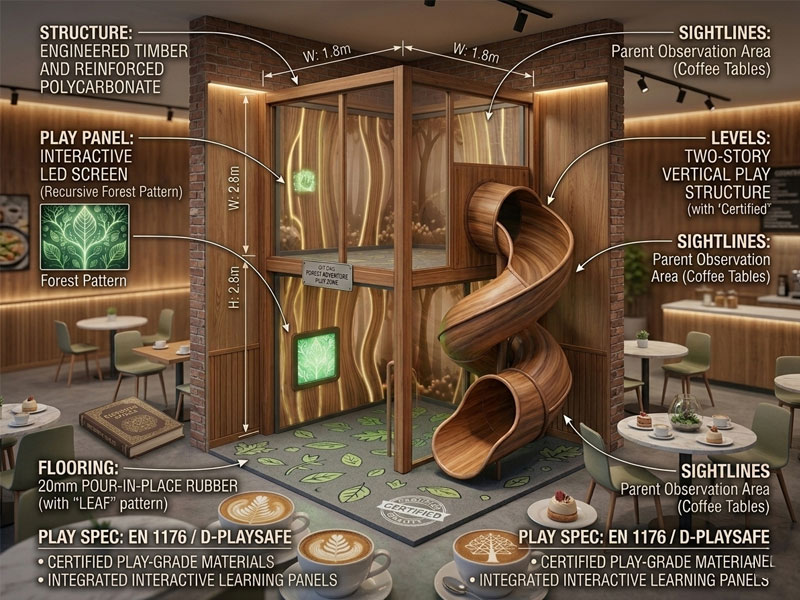
The Emergence of the Micro-Playground in the Experience Economy
The global commercial landscape is currently navigating a pivotal transition where the traditional boundaries between hospitality, education, and entertainment are increasingly blurred. This phenomenon, often termed the “Experience Economy,” necessitates that businesses provide more than just a core product; they must curate an environment that addresses the diverse needs of the modern family unit. For daycares and restaurants, the primary challenge in this new era is the reconciliation of limited physical square footage with the growing demand for high-quality, engaging, and safe recreational spaces for children. The solution lies in the rise of the “micro-playground”—a high-density, highly customized play environment typically occupying less than 2,500 square feet, and often as little as 100 to 500 square feet in satellite locations.
Urbanization and the subsequent rise in real estate costs have made sprawling family entertainment centers (FECs) a capital-intensive venture for many entrepreneurs. However, the micro-playground model offers a lean alternative that allows smaller venues like local diners, boutique daycares, and shopping mall kiosks to compete effectively. These compact designs are not merely scaled-down versions of larger parks; they represent a specialized discipline of design that prioritizes verticality, multi-functionality, and immersive theming to maximize “play value” per square foot. As cities become more congested, these “pocket playgrounds” serve as essential hubs for physical development and social connection, fulfilling a critical role in community well-being while driving significant business benefits.
Market Dynamics and the 2025-2026 Projections
The indoor playground industry is experiencing a period of robust expansion, with the family entertainment center market projected to grow from approximately $35 billion in 2024 to over $40 billion by 2025. This upward trajectory is mirrored in the micro-playground segment, as businesses across various sectors recognize that a dedicated play area acts as a powerful “magnet” for families. Statistical analysis indicates that facilities incorporating an indoor playground experience a 30% higher attendance rate than those without such amenities. This surge is driven by a demographic shift: parents, particularly those in the $75,000 to $150,000 annual income bracket, are increasingly seeking out “experiential” destinations where their children can be safely entertained while the adults engage in business or leisure.
As we look toward 2026, the market is characterized by a “premiumization” of play. Consumers are no longer satisfied with generic padded zones; they demand high-tech, sustainable, and inclusive environments. This shift is reflected in the equipment investment costs, which are increasingly weighted toward durable, safety-certified materials and smart technology rather than just sheer volume. The following table outlines the comparative investment profiles for various scales of play environments as the market moves into 2026.
| Facility Type | Typical Size (sq. ft.) | Estimated Equipment Investment (USD) | Core Target Demographic | Revenue Model Primary Driver |
| Micro-Play Corner | 100 – 500 | $10,000 – $40,000 | Toddlers & Preschoolers | Customer dwell time (F&B) |
| Small Daycare/Cafe | 500 – 2,000 | $50,000 – $100,000 | Children ages 1–6 | Membership, play sessions |
| Mid-Sized FEC | 2,000 – 10,000 | $150,000 – $300,000 | Children ages 2–12 | Birthday parties, group events |
| Adventure Park | 10,000+ | $300,000+ | Multi-generational | High-capacity ticket sales |
The economic rationale for micro-playgrounds in restaurants and daycares is rooted in the optimization of existing real estate. For a restaurant, a 300-square-foot investment that increases customer dwell time by 20% can lead to a substantial rise in per-check averages, as parents are more likely to order appetizers, desserts, or additional drinks while their children are occupied.
Core Design Philosophy for Spatially Constrained Venues
In a micro-playground, the traditional “sprawl” of playground equipment is replaced by a philosophy of vertical integration. When ground space is limited, the only direction for expansion is upward. This approach not only preserves the limited footprint of a restaurant or daycare but also introduces a layer of challenge and excitement that children find inherently engaging.
The Verticality Metric: Maximizing Use Zones
Vertical play structures stack elements such as cargo nets, spiral slides, and tiered climbing platforms. For a facility with a ceiling height of 10 to 12 feet, it is possible to create two distinct levels of play, effectively doubling the usable square footage without moving a single wall. In high-ceiling venues (18–25 feet), “skyscraping” towers can be installed, providing a landmark attraction that is visible from across the establishment.
The engineering of these vertical units must account for the specific “fall height” and “use zone” requirements mandated by safety standards. For instance, ASTM standards require 6 feet of clearance around most equipment, but this can be reduced to 3 feet for toddler-specific structures if the platform height is kept under 32 inches. By utilizing vertical walls for sensory panels or climbing holds, designers can activate the perimeter of a room, leaving the central floor area open for movement and circulation.
Multi-Functional and Modular Systems
Modular design is the “Swiss Army Knife” of micro-playground customization. These systems consist of interchangeable components that can be reconfigured or expanded as the business evolves. For a daycare, modularity allows for “seasonal restructuring,” keeping the environment fresh and engaging for long-term enrollees without requiring a full redesign.
Key modular elements include:
- Movable Barriers: Systems like Everblock walls allow operators to partition play areas for private events or reorganize the layout based on the day’s attendance.
- Storage-Integrated Furniture: In daycares, furniture must perform double duty. Storage benches with deep bins can house bulkier toys like soft blocks, while the tops serve as seating for parents or educators.
- Foldable Play Equipment: Elements such as the “Learn ‘N Fold” climbing towers or foldable balance beams allow for high-activity play that can be tucked away during evening hours or multi-use events.
Creative Zoning and Sightline Engineering
A well-designed micro-playground must manage the “traffic flow” to prevent collisions and overcrowding. “Creative Zoning” involves dividing the space into age-appropriate sections. For example, a restaurant play area might feature a “Tiny Tots Zone” (ages 0–3) with foam shapes and sensory walls, separated by a low barrier from a “Junior Adventure Zone” (ages 4–8) featuring a small multi-level climber.
For hospitality venues, sightlines are a critical operational requirement. Parents want the ability to supervise their children without physically leaving their dining table or coffee station. This is achieved through:
- Low-Profile Barriers: Using half-height walls or glass partitions to maintain a clear line of sight while containing noise and activity.
- Centralized Pedestals: Designing play structures around a central axis to eliminate “blind spots” where children might be hidden from view.
- Strategic Seating: Positioning the cafe or dining area so that it wraps around the play zone, providing a 360-degree view of the activity.
The 2025-2026 Trend Forecast: Immersive Themes and Cyber-Tech
The aesthetic of play is shifting away from the saturated “primary color” palettes of the past toward more sophisticated, themed, and technologically integrated environments. In 2025 and 2026, the playground is no longer just a place to jump; it is a portal to another world.
Immersive Theming and Brand Identity
Customized theming allows a business to extend its brand story into the play area. A nautical-themed restaurant might install a play structure shaped like a pirate ship, while a modern urban daycare might opt for a “Tiny City” theme with kid-sized grocery stores and construction sites. These immersive environments utilize custom 3D volumes, vinyl prints, and textured materials to create a rich sensory experience that fosters imaginative play.
The Rise of the Cyber-Tech Aesthetic
For venues catering to older children or those wishing to project a modern, high-tech image, the “Cyber-Tech” style is the leading trend for 2026. This look is defined by deep blue and electric purple palettes, neon LED strands woven through the structures, and surfaces that react under ultraviolet light. This aesthetic is particularly effective for “Ninja Courses” or trampoline zones, bridging the gap between traditional soft play and active entertainment centers for tweens.
Digital Integration: Smart Play for Small Footprints
Interactive technology offers a high-impact way to add play value without the physical footprint of traditional equipment.
- Interactive Floor Projectors: Systems that project games onto the floor allow children to jump and stomp on animated targets, providing intense physical activity in a completely flat space.
- AR (Augmented Reality) Walls: LED walls that respond to touch or motion sensors transform a standard wall into a dynamic gaming station.
- Smart Play Sensors: Incorporating sensors into climbing walls or obstacle courses allows for gamification, with digital leaderboards and scoring systems that encourage friendly competition and repeat visits.
Technical Excellence: Safety Standards and Material Science
The customization of a micro-playground is governed by a complex framework of safety regulations designed to protect children from injury while maximizing the facility’s durability in high-traffic commercial settings.
ASTM F1918 and the Physics of Soft Contained Play
ASTM F1918-22 is the definitive safety standard for “Soft Contained Play Equipment” in North America. Compliance with this standard is essential for passing local safety inspections and securing insurance coverage.
Key engineering considerations under ASTM F1918 include:
- Entrapment Prevention: Designers must ensure that no gaps between bars, steps, or openings fall between 3.5 inches and 9 inches, which are the dimensions that could potentially trap a child’s head while allowing their body to pass through.
- Crush and Shear Points: Maintaining a minimum 12-inch clearance between any moving components, such as swings or spinners, to prevent limb injuries.
- Fall Protection and Attenuation: Any surface beneath equipment with a fall height greater than 18 inches must be covered with impact-absorbing material, such as poured-in-place rubber or foam tiles.
The efficacy of these safety measures is often represented by the “G-max” and “HIC” (Head Injury Criterion) values, which measure the shock-absorbing capacity of the flooring. For a micro-playground, the relationship between platform height ($h$) and required surfacing depth ($d$) can be modeled as:
$$HIC = \frac{1}{(t_2 – t_1)} \int_{t_1}^{t_2} a(t) \, dt < 1000$$
where $a(t)$ is the acceleration during a fall impact. Maintaining an HIC below 1000 is the critical threshold for preventing severe head injuries.
Material Innovation: Fire Resistance and Antimicrobial Properties
In the enclosed environment of a daycare or restaurant, the chemical composition of play materials is subject to strict scrutiny.
- Fire Propagation: All textiles and films must comply with NFPA 701, and plastics must meet UL 94 flammability standards to ensure they do not facilitate the rapid spread of fire.
- Antimicrobial Coatings: Post-pandemic innovations include the application of silver-ion or similar antimicrobial coatings to high-touch surfaces like handrails and slide exits, reducing the microbial load between cleaning cycles.
- Eco-Friendly Plastics: Manufacturers are increasingly utilizing recycled high-density polyethylene (HDPE), which is durable, non-toxic, and resistant to the harsh disinfectants required for daily sanitation.
Hygiene 2.0: The Future of Sanitation in Play Areas
The perceived cleanliness of a play area is the single most important factor in a parent’s decision to return to a facility. A study found that 78% of parents prioritize venues with visible safety and hygiene certifications. For daycares and restaurants, this necessitates a transition from “reactive cleaning” to a “proactive sanitation” model.
The Three Pillars of Sanitation: Clean, Sanitize, Disinfect
Operational protocols must distinguish between the three levels of hygiene:
- Cleaning: The physical removal of dirt and organic matter using soap and water. This is the prerequisite for all further steps.
- Sanitizing: The reduction of bacteria to safe levels (typically a 99.9% reduction). This is the standard for daily maintenance of non-porous surfaces.
- Disinfecting: The elimination of all pathogens listed on a product’s label, including viruses and fungi. This is required for high-touch areas and after “body fluid incidents”.
UV-C Germicidal Irradiation: A Technological Breakthrough
UV-C technology, operating at a wavelength of 254nm, offers a chemical-free way to disrupt the DNA and RNA of pathogens, preventing them from replicating.
- UV-C Cabinets: These units allow daycares to disinfect shared tech, toys, and learning tools in under two minutes, achieving up to 99.999% germ removal.
- Upper-Room Air Disinfection: Ceiling-mounted UV-C units continuously treat the air in high-occupancy play zones, reducing the concentration of airborne viruses like influenza and SARS-CoV-2.
- Effectiveness: Unlike manual wiping, which is subject to human error and “missed spots,” UV-C provides a consistent, measurable dosage of germicidal energy every time.
| Sanitation Method | Speed | Chemical Use | Target Pathogens | Application |
| Manual Wiping | Slow | High | Bacteria, Dirt | Visible surfaces |
| Electrostatic Spraying | Moderate | High | Full range | Large structures |
| UV-C Cabinet | Fast (<2 min) | None | Viruses, Spores | Shared toys, tech |
| Air UV-C | Continuous | None | Airborne droplets | Entire room |
Economic Analysis: Investment, ROI, and Payback Models
The decision to install a micro-playground is a capital-intensive strategic move. For small business owners, understanding the “unit economics” of play is vital for long-term sustainability.
CAPEX Breakdown: The Initial Investment
The “Three Pillars” of playground investment are infrastructure, equipment, and launch expenses. For a micro-playground in a restaurant or daycare, equipment typically accounts for 60% of the initial budget, followed by installation and facility renovations.
Typical Startup Cost Estimates (2025-2026):
- Specialized Equipment: $20,000 – $150,000 (depending on tech integration).
- Facility Build-out (Flooring, Lighting, HVAC): $10,000 – $50,000.
- Installation & Safety Certification: $5,000 – $20,000.
- Permits, Insurance, and Legal Fees: $5,000 – $15,000.
OPEX and the “Utilization Lever”
Operating an indoor play area requires high fixed overhead, particularly for rent, payroll, and insurance. Monthly operating costs for a dedicated small play center (approx. 2,000 sq. ft.) can reach $44,000, driven by:
- Rent: $10,000+ per month (location dependent).
- Payroll: $25,000+ (for monitors and party hosts).
- Insurance Premiums: $5,000 – $15,000 annually.
Profitability is heavily dependent on the “utilization rate”—the percentage of peak hours where the facility is at capacity. For restaurants, this is less about ticket sales and more about “secondary consumption.” If the play area drives a 20% increase in weekend family dining volume, the playground pays for itself through increased food margins.
ROI and Payback Periods
In the U.S. market, a well-managed indoor play facility can expect to recover its initial investment within 8 to 14 months. For a restaurant or daycare, the payback may be indirect but no less significant. For instance, a daycare that can charge a $50/month “premium” for access to a state-of-the-art interactive play zone can generate an additional $60,000 in annual revenue from 100 students, covering the cost of a $50,000 micro-playground in less than a year.
The Implementation Roadmap: A 12-Week Strategic Plan
A micro-playground project typically moves from concept to grand opening in approximately 12 weeks, provided there are no significant supply chain disruptions.
Phase 1: Planning and Conceptual Design (Weeks 1-2)
This phase involves site visits, demographic research, and the creation of initial 3D renderings. Operators must define their target age group and business model—whether the play area is a free amenity or a revenue-generating attraction.
Phase 2: Ordering and Production (Weeks 3-7)
Custom play structures take time to manufacture. Simple designs may be completed in 15 days, while complex, tech-integrated structures require 20 to 30 working days. This is also the time to secure necessary building permits and “Certificate of Occupancy” (CO) approvals, which can take 4 to 8 weeks.
Phase 3: Logistics and Facility Preparation (Weeks 8-9)
While the equipment is in transit, the venue must be prepared. This includes installing specialized lighting, sound-absorbing acoustic panels, and impact-attenuating flooring. Floor load ratings must be verified for elevated towers.
Phase 4: Installation and Safety Audits (Weeks 10-11)
Professional installation of a micro-playground typically takes 3 to 7 days. Following assembly, a certified safety inspector should conduct a final audit to ensure compliance with ASTM and CPSC standards.
Phase 5: Staff Training and Soft Opening (Week 12)
Before the grand opening, staff must be trained on active supervision, sanitation protocols, and emergency response procedures. A “soft opening” allows the operator to test traffic flow and identify any minor operational issues before the full launch.
Operational Excellence and Risk Mitigation
Managing a commercial play area involves a perpetual commitment to risk mitigation. Even a small incident can lead to significant liability and reputational damage.
The Maintenance Log: Accountability and Longevity
Regular maintenance not only ensures safety but also protects the long-term value of the equipment. Operators should maintain a daily log that includes:
- Visual inspections of netting and hardware.
- Documentation of sanitation cycles.
- Records of “preventative care,” such as lubricating moving parts or replacing worn padding.
Staff as the First Line of Defense
Well-trained monitors are essential for preventing “dangerous mismatches” in ability when different age groups share a space. Staff must be empowered to enforce rules—such as the “shoes off, socks on” policy—which is critical for both safety and hygiene. Furthermore, the presence of trained staff reduces the risk of overcrowding, which is a major cause of collisions in micro-playgrounds.
Liability Management: Waivers and Signs
While insurance is the primary safety net, proactive risk management includes:
- Liability Waivers: Having an attorney draft a state-specific waiver that parents sign before their children enter.
- Rule Signage: Prominently displaying height limits and play rules to demonstrate that the business is acting responsibly.
- Surveillance: Overhead surveillance footage allows parents to monitor their kids from the cafe while providing a record in the event of an incident.
Nuanced Conclusions and Strategic Recommendations
The micro-indoor playground is a transformative business tool that allows restaurants and daycares to capitalize on the multi-billion dollar family entertainment market within a constrained physical footprint. Success in this domain is not determined by size, but by the precision of the customization and the rigor of the operational standards.
By prioritizing verticality, modular design, and immersive theming, small business owners can create high-impact recreational hubs that drive significant ROI. For restaurants, the playground is an “experiential” upgrade that increases dwell time and per-check averages. For daycares, it is a developmental necessity that provides a competitive edge and supports premium pricing models.
As the market moves toward 2026, the integration of smart technology (AR, sensors) and advanced hygiene (UV-C, antimicrobial materials) will become standard expectations for families. Operators who invest early in high-quality, safety-certified equipment and rigorous sanitation protocols will not only mitigate their risks but also solidify their position as the preferred choice for the modern, safety-conscious parent. Ultimately, the micro-playground is more than just a place to play; it is a strategic investment in the long-term growth and community relevance of the business.
Frequently Asked Questions (FAQ)
1. What is the minimum square footage required for a functional micro-playground?
A functional toddler soft play area can be integrated into as little as 100 to 150 square feet. For a multi-level structure that accommodates children ages 4 to 8, a footprint of 300 to 500 square feet is typically recommended.
2. How do I choose between a themed structure and a tech-integrated playground?
This depends on your target demographic and brand aesthetic. Themed structures (e.g., pirate ships, forests) are excellent for imaginative play and brand storytelling. Tech-integrated play (AR walls, projectors) is ideal for sleeker, modern environments and can be updated with new games, though it requires more infrastructure like power and stable Wi-Fi.
3. What are the main maintenance costs for a small indoor play area?
The primary ongoing costs include specialized cleaning and sanitizing agents, replacement of high-wear items like padding or netting, and annual professional safety audits. For a small facility, these costs generally range from $500 to $1,000 per month.
4. Can a micro-playground really be profitable for a small cafe or restaurant?
Yes, though the “profit” is often indirect. By increasing family attendance and customer “dwell time,” a playground can drive higher food and beverage sales. Additionally, many small venues use the play area to anchor birthday party packages, which can account for 30% of total revenue.
5. How long will a commercial-grade micro-playground last?
High-quality, ASTM-compliant equipment is designed for high-frequency commercial traffic and typically has a service life of 5 to 10 years with proper maintenance. Modular systems are particularly valuable as they allow for individual components to be refreshed or replaced without a full redesign.


