
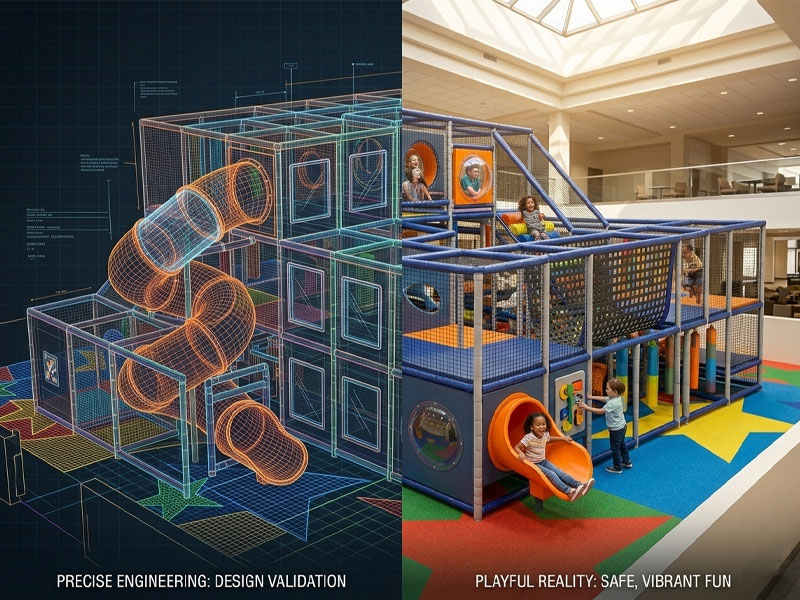
The global market for indoor playgrounds and Family Entertainment Centers (FECs) has entered a phase of unprecedented sophistication, driven by shifting consumer expectations and a rapid evolution in manufacturing technology. As the FEC sector is projected to expand from a valuation of approximately $35 billion in 2024 to over $40 billion by the conclusion of 2025, the industry is witnessing a pivot toward highly customized, technologically integrated, and safety-certified play environments. This growth is facilitated by a fundamental change in how equipment is procured, transitioning from fragmented, multi-vendor models to a consolidated “one-stop” sourcing ecosystem. By leveraging factory-direct relationships, investors can bypass the significant markups associated with intermediaries while gaining direct control over the technical specifications and safety benchmarks that define a successful venue. The integration of 3D visualization during the design phase has further enhanced this process, allowing for the creation of immersive environments that are optimized for both child development and commercial profitability.
The move toward factory-direct sourcing is primarily motivated by the need for economic efficiency and structural transparency in an increasingly competitive landscape. For the modern playground operator, purchasing directly from a manufacturer often translates to cost savings of between 30% and 50% compared to local suppliers who do not possess their own production facilities. These savings are not merely about lower price points; they represent a reallocation of capital that can be directed toward high-margin attractions or advanced interactive technologies. Furthermore, factory-direct engagement ensures that the “manufacturing logic” is preserved from the initial engineering sketch to the final installation. Professional manufacturers utilize advanced 3D engineering software to deconstruct complex structures into precise data for every galvanized steel pipe and foam component, ensuring that the physical product is a perfect replica of the digital design. This level of technical oversight is vital for maintaining compliance with rigorous international safety standards, such as ASTM F1918 in North America and EN 1176 in Europe, which govern everything from entrapment zones to the flammability of soft play materials.
The Economic Logic of Factory-Direct Procurement
The decision to source indoor playground equipment directly from the factory is a strategic move that addresses the core financial challenges of launching a Family Entertainment Center. In traditional procurement models, the involvement of multiple distributors and agents often inflates the final cost of equipment without adding proportional value to the structural quality or safety of the product. By eliminating these intermediaries, operators can access “factory-direct” pricing, which serves as the bedrock of a competitive business plan. This model also facilitates a more transparent understanding of the total cost of ownership (TCO), allowing buyers to negotiate based on material grades and production timelines rather than arbitrary retail markups. When an operator works directly with a manufacturer like Weiroo Play or NinescapeLand, they are effectively building a partnership that extends into the long-term operational phase, ensuring a reliable supply of replacement parts and technical support.
Quality assurance in a factory-direct model is significantly more robust because the manufacturer maintains full control over the raw material supply chain. High-quality indoor playgrounds require a specific grade of galvanized steel for the framework, typically with a diameter of 48mm and a wall thickness of 2mm to ensure load-bearing stability across multi-level structures. Sourcing directly allows the buyer to verify that no recycled plastics are used in the LLDPE (Linear Low-Density Polyethylene) components and that the PVC vinyl covers are non-toxic, anti-static, and anti-crack. This direct oversight is particularly important for meeting stringent chemical safety regulations, such as the European Union’s REACH regulation, which restricts the use of phthalates in children’s products. By securing these quality guarantees at the source, operators can build parental trust and reduce the long-term maintenance costs associated with premature wear and tear.
| Material Component | Factory-Direct Specification | Benefit to Operator |
| Main Frame Pipes | Galvanized Steel (48mm x 2mm) | Superior structural integrity and load capacity |
| Soft Play Covers | 0.55mm PVC Vinyl (Anti-toxic) | Easy to sanitize, flame retardant, durable |
| Plastic Components | 100% Virgin LLDPE | No recycling impurities, higher impact resistance |
| Safety Netting | High-density fire-resistant nylon | Prevents falls and entrapment, meets fire codes |
| Fasteners/Clamps | Galvanized cast iron | Secure connections, rust-resistant for long life |
The financial impact of factory-direct sourcing is most visible when analyzing the initial Capital Expenditure (CapEx) of a project. For a standard 500-square-meter indoor park, equipment costs can range from $50,000 to $60,000 when sourced directly, representing roughly 50.5% of the total startup capital required. By contrast, sourcing through a local distributor can push these costs upward of $100,000 for the same equipment, significantly extending the time required to reach the break-even point. This initial saving allows investors to allocate more resources to the “ancillary areas”—such as the cafe build-out or high-end party rooms—which are critical for driving the “upsell” revenue that ultimately determines the facility’s profitability. Consequently, the factory-direct model is not just a procurement choice; it is a financial strategy designed to accelerate the return on investment (ROI) and provide a buffer against the high fixed costs of rent and labor.
The Role of 3D Visualization in Design and Safety
The integration of 3D visualization has transformed the indoor playground industry from a “catalog-buying” experience into a high-precision engineering field. Modern 3D design software allows manufacturers to create a digital twin of the playground, providing a comprehensive view of how different modules—such as slides, climbing walls, and ball pits—interact within the physical constraints of a specific venue. This process is essential for identifying potential safety hazards that are often invisible in 2D layouts. For instance, software decomposition can detect head entrapment zones (openings between 3.5 and 9 inches) or inadequate “use zones” around high-motion equipment like slides and swings. By resolving these issues in the digital phase, manufacturers can ensure that the final product arrives on-site as a fully compliant, “plug-and-play” system that meets all local building and safety codes.
Beyond safety, 3D visualization serves as a vital tool for space optimization and revenue management. A well-designed indoor park typically adheres to the “70/30 Rule,” where 70% of the square footage is dedicated to the active play area and 30% is reserved for reception, cafes, and restrooms. 3D modeling allows designers to test different vertical configurations, such as sky-high towers and multi-story spiral slides, to maximize the “static capacity” of the park without increasing the footprint. This is particularly advantageous in urban environments where real estate costs are high, as it allows for a higher number of simultaneous players and thus a higher potential revenue per square meter ($ \text{Revenue/m}^2 $). The ability to visualize these layouts in high-fidelity 3D also helps in theme selection, ensuring that the aesthetic “story” of the park is immersive and consistent across all elements.
The marketing value of 3D renderings cannot be overstated for new business owners. These visuals allow investors to present a tangible “vision” to lenders, landlords, and the local community long before the equipment is even manufactured. High-quality 3D renders are frequently used in “founding member” pre-sale campaigns to generate cash flow during the construction phase, a strategy that can significantly reduce the financial pressure of the first few months of operation. Furthermore, 3D visualization facilitates a more collaborative design process between the operator and the manufacturer. Clients can request modifications to themes—ranging from “Jungle Safari” to “Futuristic Space Station”—and see the impact on both the aesthetic appeal and the functional flow of the park in real-time. This synergy ensures that the final installation matches the operator’s vision while adhering to the technical realities of manufacturing and safety compliance.
Comprehensive One-Stop Sourcing: A Turnkey Approach
The “one-stop sourcing” model represents the ultimate evolution of the playground procurement process, providing a seamless transition from the first concept sketch to the grand opening. This holistic approach integrates several distinct stages, including professional consultation, bespoke design, manufacturing, logistics, and on-site installation. By consolidating these services under a single manufacturing partner, operators mitigate the risks of “scope creep” and communication failures that often occur when dealing with multiple vendors. A one-stop partner like Funlandia or Dreamland Playground acts as a project manager, ensuring that the equipment design is balanced with structural integrity, safety performance, and the investor’s financial goals. This turnkey model is especially beneficial for first-time buyers who may be unfamiliar with the complexities of international trade and safety certification.
A critical component of the one-stop service is the preliminary investment assessment and ROI guidance. Professional project managers use historical data and industry benchmarks to help clients develop realistic budgets that account for equipment, surfacing, installation, and even “hidden” costs like permits and site preparation. For a commercial playground, these experts often recommend an allocation based on a reference range of approximately $200 to $300 per square meter, which provides a balanced investment for high-durability attractions. This early consultation phase also includes site layout guidance, helping operators choose buildings with appropriate ceiling heights and column placements to maximize the effectiveness of multi-level structures. By integrating these business insights with the physical design, the one-stop model ensures that the playground is built for commercial success rather than just aesthetic appeal.
The logistics and installation phases of the one-stop model are designed to provide a “headache-free” experience for the operator. Manufacturers handle the complexities of international shipping, including the coordination of 40HQ containers and the preparation of all necessary customs documentation, such as the Bill of Lading and Commercial Invoice. Once the equipment arrives at the site, the manufacturer typically provides a team of expert installers who are intimately familiar with the structure’s engineering. These teams ensure that every galvanized steel pipe is anchored correctly and that the impact-absorbing flooring meets the “critical fall height” requirements of the equipment. This end-to-end oversight continues into the post-opening phase, with professional manufacturers offering “after-sales” support and maintenance insights to ensure the facility remains safe and profitable for its entire five-to-ten-year lifespan.
| Sourcing Stage | One-Stop Service Activity | Strategic Outcome |
| Phase 1: Planning | Business plan consultation & ROI analysis | Realistic budgeting and financial feasibility |
| Phase 2: Design | 3D modeling and themed visualization | Optimized layout for safety and high-capacity play |
| Phase 3: Production | Factory-direct manufacturing & QC | Guaranteed material quality and safety compliance |
| Phase 4: Logistics | Container optimization and customs docs | Reduced shipping costs and streamlined clearance |
| Phase 5: Install | Professional on-site assembly | Safe, structural-sound installation matching the 3D design |
| Phase 6: Support | After-sales maintenance & spare parts | Extended equipment life and reduced operational risk |
Adherence to Global Safety and Compliance Standards
Safety is the non-negotiable prerequisite for any commercial indoor playground, and adherence to international standards is the primary mechanism for mitigating liability and protecting children. The most recognized standards globally are ASTM F1918 in North America and the EN 1176 series in Europe. ASTM F1918 (Standard Safety Performance Specification for Soft Contained Play Equipment) is the first standard specifically designed for indoor environments and covers rigorous testing for mechanical safety, non-toxicity, and fire resistance. EN 1176, used across Europe and increasingly adopted in other regions, provides detailed requirements for playground design, installation, and maintenance, with specific sections like EN 1176-10 dedicated to the complexities of indoor soft play. A professional factory-direct manufacturer will provide documentation verifying that every component of the playground meets or exceeds these standards.
Fire safety is a particularly critical concern for indoor facilities, as the high density of soft play materials (foam, PVC, and netting) requires strict flammability controls. In the United States, materials must often comply with NFPA 701 (Standard Methods of Fire Tests for Flame Propagation of Textiles and Films) or UL 94 for plastic components. Furthermore, the floor covering within a play structure is required to meet Class I interior floor finish classifications when tested in accordance with NFPA 253. In high-occupancy commercial settings, many building codes also demand that interior finishes meet “Class A” ratings under ASTM E84, which limits the Flame Spread Index (FSI) to a range of 0-25 and the Smoke Developed Index (SDI) to a maximum of 450. By sourcing directly from a certified factory, operators can ensure that their facility will pass the rigorous fire marshal inspections required for a certificate of occupancy.
Maintenance and regular inspections are the third pillar of a comprehensive safety strategy. Professional manufacturers provide detailed checklists for daily, weekly, and monthly inspections to ensure the ongoing integrity of the structure. These checks focus on structural stability (checking for loose fasteners), surface conditions (inspecting for torn PVC or exposed foam), and hygiene. For instance, nets with holes larger than 9 inches must be repaired immediately to prevent head entrapment. Moreover, impact-absorbing surfaces, such as foam tiles or poured-in-place rubber, must be regularly inspected for compaction or displacement to maintain their “critical fall height” properties. This culture of safety not only protects the users but also enhances the business’s brand reputation, as parents are more likely to return to a facility that is visibly well-maintained and compliant with international safety norms.
Technological Integration and the Future of Play (2025-2026)
The indoor playground industry is currently undergoing a digital revolution, with “Smart Play” and interactive technologies becoming standard features rather than niche additions. As we look toward 2025, the integration of Augmented Reality (AR), Virtual Reality (VR), and motion-sensor technology is transforming static play structures into dynamic, multi-sensory experiences. Interactive floors and walls use projection technology to turn simple surfaces into touch-sensitive game zones where children can play digital soccer, pop virtual bubbles, or engage in AR scavenger hunts. These technologies are designed to enhance physical activity rather than replace it; for example, interactive climbing walls with LED-light paths challenge children to follow specific routes, blending physical strength building with cognitive problem-solving.
The business value of these technological integrations extends beyond mere engagement. Smart play systems can collect anonymized data on how equipment is used, providing operators with insights into which attractions are most popular and when maintenance might be required. Gamification is also a powerful tool for driving repeat visits; systems like ninja courses can use RFID wristbands to track times and display scores on real-time leaderboards, encouraging children to return to beat their personal bests or compete with friends. Furthermore, technology is facilitating greater inclusivity. Sensory-friendly zones with adjustable lighting and sound can be tailored for neurodiverse children, while interactive panels provide engaging activities for children with mobility devices, ensuring the playground is a welcoming space for all abilities.
Sustainability is another key trend shaping the 2025-2026 outlook. Environmental consciousness is increasingly important to modern families, leading playground manufacturers to adopt eco-friendly materials such as recycled plastics, bamboo, and low-VOC finishes. These “green” playgrounds not only reduce the facility’s carbon footprint but also align with the values of the target audience, enhancing brand trust and community support. When combined with the operational efficiency of factory-direct sourcing and the technical precision of 3D visualization, these innovations represent the future of the industry: a “one-stop” solution that is economically sustainable, technologically advanced, and socially inclusive.
Financial Modeling: ROI and Break-Even Analysis
An indoor playground is a capital-intensive business that requires a rigorous financial blueprint to ensure long-term viability. The “Capacity Math” is the most critical calculation for projecting revenue: operators must determine the maximum number of children their facility can safely accommodate at one time. The industry standard recommends a “Golden Formula” of approximately $3 \, \text{m}^2/\text{child}$ for the active play area. For a 600-square-meter building, an operator might have 420 square meters of play structure (following the 70/30 Rule). Dividing this by three gives a maximum capacity of 140 simultaneous players. In mature markets like the US or UK, charging a premium ticket price of $25 to $35 per hour can result in gross ticket revenue of over $4,000 per hour during peak weekend times.
To accelerate the path to profitability, professional operators focus on the “Revenue Triangle,” where ticket sales are supplemented by high-margin ancillary income. Birthday parties are the most profitable product, often accounting for 35% of total revenue due to their pre-booked nature and high average spend per head. Food and Beverage (F&B) sales should aim for a gross margin of 65%, while merchandise like non-slip socks adds a final 5% to the revenue mix. To maintain a healthy EBITDA margin of 25-35%, operators must strictly control their “Expense Ratios.” Rent should never exceed 15-18% of projected monthly gross revenue, and labor costs should be kept between 20-25%. If rent exceeds the 30% mark, the business enters what analysts call the “Death Trap,” where the fixed costs overwhelm the operational profits.
| Financial Metric | Industry Benchmark | Calculation / Note |
| Active Play Area | 70% of total floor space | Maximize revenue-generating space |
| Max Capacity | $3 \, \text{m}^2$ to $4 \, \text{m}^2$ per child | Safety and throughput calculation |
| Break-Even Point | 12 to 18 months | Typical for factory-direct operations |
| Revenue / $\text{m}^2$ | $800 to $1,200 annually | Performance benchmark for established parks |
| Rent Rule | < 18% of projected revenue | Critical for long-term solvency |
| EBITDA Margin | 25% to 35% | Healthy operational profit target |
The break-even timeline for a factory-direct indoor playground is remarkably efficient when compared to other entertainment models. While a franchise model might take 24 to 36 months to recoup its initial investment due to high ongoing fees, a well-managed independent park can achieve break-even in just 12 to 18 months. This rapid timeline is supported by the lower CapEx achieved through factory-direct procurement and the use of 3D visualization to optimize the park’s layout for maximum throughput on weekends. By reinvesting early profits into “maintenance reserves” (typically 1-2% of revenue) and periodic equipment upgrades, operators can maintain high customer satisfaction and ensure the long-term competitiveness of their brand in a growing market.
Logistics and International Shipping Realities
For investors sourcing directly from overseas factories, understanding the logistical journey is essential for meeting opening deadlines. Most commercial indoor playgrounds are considered “Light Cargo,” and shipping costs are calculated based on volume (CBM) rather than weight. A 40HQ container, the industry standard for these projects, holds approximately 68 CBM, and a typical 300 to 400-square-meter park will usually require one or two of these containers. It is critical to account for “The Container Reality”: soft play pads and foam items are bulky and take up significant space, so packing efficiency is a key factor in final shipping quotes. Professional manufacturers provide the Packing List and Bill of Lading well in advance, and operators are advised to hire a local customs broker to navigate the final “customs & delivery” phase, which typically takes 7 to 10 days once the ship reaches the port.
The timeline from the initial deposit to the grand opening requires careful management. Production of a standard 300-square-meter park takes approximately 15 days, while a 1,000-square-meter “mega-park” requires around 35 days. The ocean journey itself is the most variable phase: 15-25 days to the US West Coast and 25-35 days to Europe. Operators must therefore place their orders at least 3 to 4 months before their target opening date. This timeline must also include a buffer for “The Pre-Installation War Room,” where the site is prepared for the container’s arrival. It is the customer’s responsibility to unload the equipment, which arrives in large crates up to 14 feet long. Success depends on having a team of 2-3 able-bodied people and necessary tools like forklifts or loading docks ready for the delivery appointment.
| Shipping Phase | Duration (Days) | Key Responsibility |
| Production | 15 – 35 | Factory manufacturing and custom engineering |
| Ocean Journey | 15 – 40 | Depends on global destination (West vs East Coast) |
| Customs Clearance | 7 – 10 | Handled by local customs broker |
| On-Site Install | 14 – 30 | Professional team assembly of structures |
| Inspection Period | 72 hours | Customer must report damage/missing parts |
Installation is the final and most complex stage of the one-stop sourcing process. A large open-air crate contains thousands of parts, including galvanized steel pipes, foam pads, netting, and specialized fasteners. If the operator chooses professional installation, the manufacturer will send a master installer to lead the local crew. It is vital to ensure that all tools brought on-site are compatible with local electrical standards; for instance, tools from China are often 220V, which will not work in a 110V US facility without a transformer. The installation process involves anchoring the structure to the floor and walls, wrapping all metal pipes in protective foam, and securing the netting to ensure no child can fall or become trapped. Only after a final safety audit and a thorough cleaning is the park ready to welcome its first visitors, marking the successful completion of the “Factory Direct to 3D Visualization” journey.
Conclusion: Synthesizing Sourcing, Design, and Strategy
The modern indoor playground is no longer a simple collection of slides and ball pits; it is a complex, multi-functional ecosystem that requires a sophisticated approach to sourcing and design. The transition toward a “one-stop” model, anchored by factory-direct procurement and 3D visualization, has provided investors with a powerful framework for building safe, profitable, and future-proof entertainment centers. By sourcing directly from manufacturers, operators can achieve significant capital savings while ensuring that their equipment is built from premium materials and compliant with the highest international safety standards, such as ASTM F1918 and EN 1176. These savings, combined with a 3D-optimized layout that maximizes static capacity and revenue throughput, create a resilient financial model that can achieve break-even in as little as 12 to 18 months.
Looking ahead to 2025 and 2026, the industry will continue to be defined by the integration of smart technology, sustainable materials, and inclusive design principles. The “Smart Play” revolution is turning playgrounds into interactive hubs for learning and competition, while eco-friendly manufacturing is aligning the industry with the values of the modern, environmentally conscious parent. For the savvy investor, the key to success lies in choosing a manufacturing partner that can provide the full chain of service—from initial business consultation and 3D rendering to international logistics and on-site installation. This turnkey approach ensures that the final facility is not just a place for play, but a robust commercial asset that delivers long-term value to children, families, and the community.
Frequently Asked Questions (FAQ)
1. How much money can I save by sourcing indoor playground equipment factory-direct? By purchasing directly from a manufacturer rather than a third-party distributor or local middleman, you can typically save between 30% and 50% on your total equipment costs. These savings occur because you eliminate the retail markups and commission fees associated with intermediaries, allowing you to invest more in high-end attractions like interactive technology or custom themes.
2. What are the most important safety standards my equipment must follow? In North America, the primary standard is ASTM F1918, which is specifically designed for soft contained play equipment. In Europe, the EN 1176 series is the standard, with EN 1176-10 being the most relevant for indoor soft play. Additionally, fire codes such as NFPA 701 (for textiles/vinyl) and ASTM E84 (for building finishes) are critical for passing fire marshal inspections in commercial settings.
3. Why is 3D visualization necessary if I already have a floor plan? A floor plan only shows a 2D layout, whereas 3D visualization allows for a high-fidelity “digital twin” of your facility. This is essential for engineering safety (identifying head entrapment zones and fall areas), optimizing vertical space to increase player capacity, and creating immersive themed environments. It also serves as a powerful marketing tool to secure financing and pre-sell memberships.
4. How long does the entire sourcing and installation process take? You should plan for a total timeline of 3 to 4 months from the moment you place your deposit. Manufacturing typically takes 15 to 35 days, followed by 15 to 40 days for ocean shipping depending on your location. Once the containers arrive and clear customs (7-10 days), professional on-site installation usually takes 2 to 4 weeks depending on the park’s size and complexity.
5. What is the “70/30 Rule” in playground design? The 70/30 Rule is a commercial design benchmark which states that 70% of your indoor playground facility should be dedicated to the “Active Play Area” (revenue-generating space), while 30% should be reserved for “Ancillary Areas” like the cafe, reception, party rooms, and restrooms. Maintaining this ratio ensures you maximize your revenue potential per square meter while still providing a comfortable experience for parents and staff.
Meta Description:
Short URL: //
Main Keyword: Direct
Related Keywords: 3D Visualization Design, , , ASTM F1918 Safety, .
1:1 SEO Thumbnail Prompt: A cinematic, high-detail 1:1 split-screen image. The left half displays a glowing 3D digital wireframe design of a colorful multi-level indoor playground with skywalks and spiral slides. The right half shows the finished physical playground in a sunlit commercial space, with children playing safely. High contrast, professional lighting, emphasizing engineering precision and vibrant fun.


