
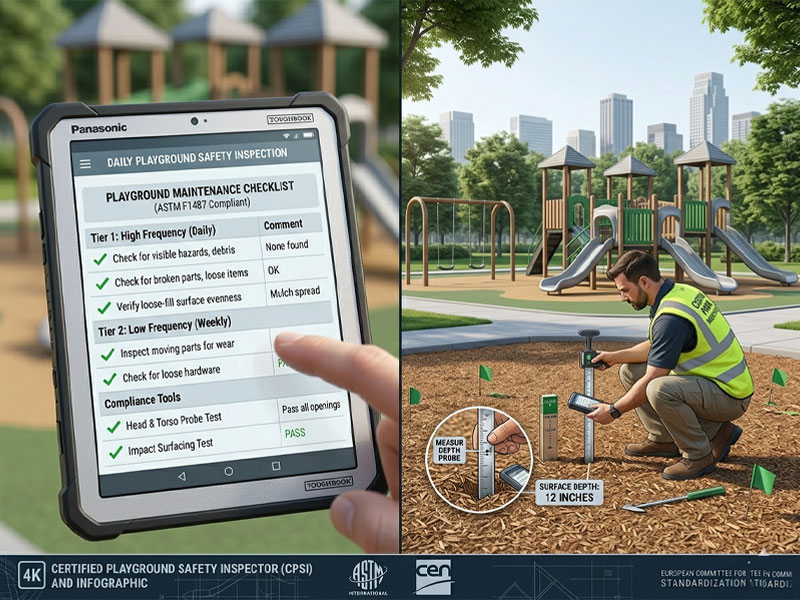
Maintaining a public playground is a rigorous operational commitment that balances child safety with the longevity of municipal and school assets. According to recent data, nearly 79% of playground-related injuries are attributed to falls, many of which could be mitigated through consistent surfacing maintenance. In 2026, with the full adoption of the ASTM F1487-25 and the updated CPSC Handbook, playground operators are expected to transition from “reactive repairs” to a “three-tier proactive inspection” model.
This checklist provides 50 actionable tasks categorized by frequency to ensure your facility meets the highest standards of care.
Daily Routine Visual Checks (12 Tasks)
Target: Immediate hazards resulting from heavy use, weather, or vandalism. Time: 5–10 minutes.
- Remove Foreign Debris: Scan for broken glass, metal shards, syringes, or trash that could cause lacerations.
- Verify Gate Functionality: Ensure self-latching gates are operational and fences are not breached.
- Address Vandalism: Inspect for graffiti, broken parts, or “user modifications” like ropes tied to structures.
- Manage Standing Water: Check for puddles in fall zones which reduce impact attenuation and indicate poor drainage.
- Identify Displaced Surfacing: Look for “bare spots” in high-use zones—specifically under swings and at slide exits.
- Sanitize Animal Waste: Remove biological hazards from sandboxes and play areas.
- Check Surface Temperature: Test metal slides and plastic surfaces for “hot spots” that could cause contact burns.
- Spot Obvious Breakage: Confirm no structural members, guardrails, or handrails have been snapped or bent overnight.
- Remove Trip Hazards: Look for newly exposed tree roots, large rocks, or uneven ground transitions.
- Clear Walkways: Sweep sand or mulch back into pits to prevent slipping hazards on nearby pavement.
- Check Signage: Ensure age-appropriateness and rule signs are visible and haven’t been defaced.
- Verify Lighting: For playgrounds with evening use, ensure all overhead lighting is functioning.
Weekly Operational Tasks (18 Tasks)
Target: Remedial maintenance, cleaning, and preventing long-term deterioration. Time: 30–60 minutes.
- Rake Loose-Fill Materials: Redistribute mulch, wood fiber, or sand to maintain even depth across the use zone.
- Clean Equipment Surfaces: Wipe down high-touch points with mild, non-toxic detergent to remove grime and allergens.
- Clear Drainage Inlets: Remove leaves and debris from catch basins to prevent ice formation in winter.
- Trim Encroaching Vegetation: Cut back thorny bushes or low-hanging branches within the 6-foot clearance zone.
- Eradicate Pests: Check for wasp nests, beehives, or ant hills under platforms and inside tube slides.
- Tighten Loose Handgrips: Test all bolt-on climbing holds or grips to ensure they do not rotate.
- Inspect Swing Seats: Look for cracks in belt seats or exposed metal cores that could pinch.
- Check Swing Chain Integrity: Scan for kinked, twisted, or excessively worn links.
- Monitor “S” Hooks: Ensure “S” hooks are not opening; the gap must be less than 0.04 inches (the thickness of a dime).
- Examine Ropes and Nets: Look for fraying in steel-cored or nylon ropes.
- Cover Exposed Footings: Re-bury any concrete anchors that have become exposed due to soil erosion or surfacing loss.
- Identify Peeling Paint: Note areas of rust or chipping paint that require sanding and refinishing.
- Stabilize Site Furnishings: Check that benches and picnic tables are firmly anchored and splinter-free.
- Audit Fence Integrity: Check for bent wire or missing slats that could create a child-sized gap.
- Empty Trash Receptacles: Prevent overflow that attracts pests and creates litter.
- Check Slide Enclosures: Ensure hood entrances at the top of slides are secure and crack-free.
- Verify Anchor Points: Shake freestanding equipment to ensure footings are rigid.
- Unwrap Tangled Swings: Disentangle chains from top rails to prevent excessive wear on hangers.
Monthly Technical Inspections (20 Tasks)
Target: Compliance testing and structural diagnostics. Time: 1–2 hours.
- Measure Surfacing Depth: Use a probe to measure depth in at least 3 high-traffic locations per equipment piece.
- Verify Fall Height Ratios: Compare measured depths against the CPSC/ASTM “Critical Fall Height” requirements (e.g., 9″ of EWF for a 7ft fall).
- Lubricate Moving Parts: Apply manufacturer-approved grease to swing hangers, track rides, and pivots.
- Torque Structural Fasteners: Use a torque wrench to verify all primary bolts meet the manufacturer’s specification.
- Head/Neck Entrapment Test: Use a 3.5-inch to 9-inch probe to check all completely bounded openings.
- Fish Probe (Partial Openings): Test V-shaped gaps to ensure they do not catch a child’s neck.
- Finger Entrapment Check: Test gaps with 8mm and 25mm rods to ensure fingers cannot get caught in moving joints.
- Toggle Test for Protrusions: Check all protrusions (specifically at slide entrances) for clothing entanglement risks.
- Inspect for Structural Rot/Rust: Check wood posts for ground-level rot and metal posts for internal corrosion.
- Test Speed Limiters: Ensure merry-go-rounds or spinners do not exceed safe rotational speeds.
- Verify Guardrail Heights: Measure that barriers and guardrails remain at compliant heights (minimum 29″–38″ depending on age).
- Check Slide Bed Joints: Ensure the transition between slide sections is smooth with no gaps (>0.125″) that catch fingers.
- Assess Spring Rocker Tension: Verify springs are not deformed and have not lost their “centering” ability.
- Audit ADA Accessible Routes: Ensure the path to the playground is firm, stable, and meets ASTM F1951.
- Detect UV Degradation: Check plastic components for “chalking,” fading, or brittleness that precedes cracking.
- Inspect All Welds: Use a magnifying lens to look for hairline cracks in structural joints.
- Clear Drainage Basins: Physically inspect subsurface drains to ensure no blockage from fine silt.
- Verify Canopy Integrity: Check shade structures for tears or loose attachment cables.
- Review Recalls: Check the CPSC website for any new safety notices regarding your specific equipment models.
- Document and Record: Log all findings and completed work orders in a permanent file for liability protection.
FAQ: Playground Maintenance Best Practices
Q: How often should I replenish loose-fill surfacing?
A: Monthly depth measurements are required. You should “top up” surfacing whenever the compressed depth falls below the minimum required for the equipment’s fall height. Standard safety practice is to add a 1–2 foot safety margin to account for settling.
Q: Can I perform these inspections myself, or do I need a professional?
A: Daily and weekly checks can be done by trained staff (custodians or park rangers). However, monthly operational and annual comprehensive audits should ideally be performed by a Certified Playground Safety Inspector (CPSI) to ensure full compliance with ASTM F1487-25.
Q: What is the single most common maintenance failure?
A: Surfacing failures. 79% of injuries involve falls, and inadequate surfacing depth is the leading contributing cause. Keeping mulch raked and at the correct depth is the most effective way to prevent serious head injuries.


