
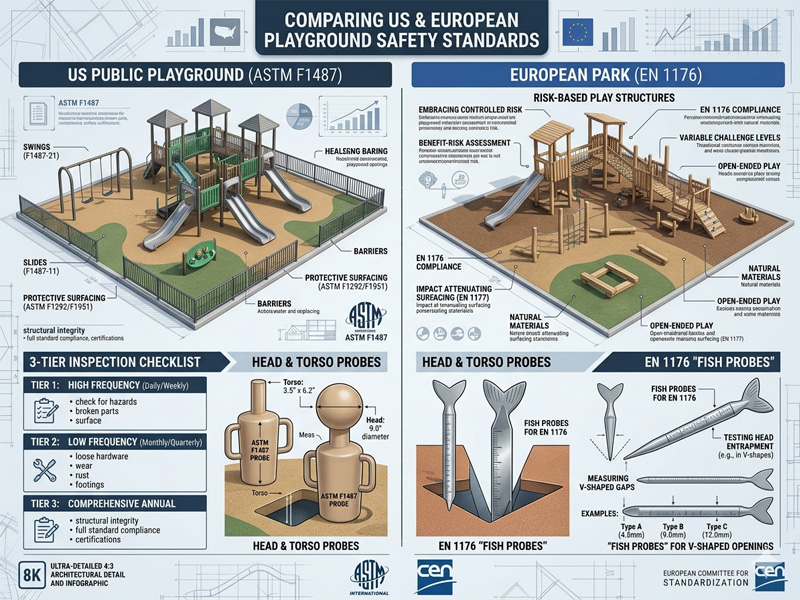
The engineering and regulation of public play spaces represent a critical intersection of pediatric developmental psychology, structural integrity, and risk management. As urban environments expand and the demand for inclusive, high-engagement playgrounds grows, manufacturers and municipal planners must navigate a bifurcated regulatory landscape dominated by two primary frameworks: the American Society for Testing and Materials (ASTM) F1487 standard and the European Committee for Standardization (CEN) EN 1176 series. While both standards share the fundamental objective of preventing life-threatening and debilitating injuries, they are built upon divergent philosophical foundations regarding the nature of play and the acceptable threshold of risk. The ASTM framework, largely used in North America and Latin America, tends toward a prescriptive, data-driven approach designed to minimize liability and eliminate specific mechanical hazards. Conversely, the EN 1176 standard, which governs the European Union and has gained significant traction in the Middle East and Southeast Asia, explicitly acknowledges the developmental value of risk, positing that “the occasional bumps and bruises have the benefit of being great motivators” for children to develop essential life skills.
The Philosophical and Regulatory Landscape of Global Play Safety
The regulatory status of these standards is perhaps the most significant practical distinction for global suppliers. In the European Union, EN 1176 is not merely a guideline but a legal requirement for market entry, enforced by customs authorities and national market surveillance bodies. For equipment to be legally placed in schools, parks, or even public-access residential areas within the EU, it must carry a Declaration of Conformity to the EN 1176 family of standards. This mandatory status contrasts with the American landscape, where ASTM F1487 is technically a voluntary consensus standard. However, this “voluntary” label is deceptive in practice. Approximately 80% of U.S. cities and major municipalities reference ASTM F1487 compliance as a prerequisite for commercial installation approval. Furthermore, failure to comply with these standards is frequently cited as a failure to meet the “standard of care” in personal injury litigation, making compliance a de facto requirement for insurance eligibility and liability protection.
Several U.S. states have taken the additional step of codifying these requirements into state law or administrative regulations, particularly for licensed childcare facilities and public schools. This regulatory patchwork requires designers to be acutely aware of jurisdictional nuances. For example, states like California, Florida, and Texas have established stringent safety programs that mandate regular inspections aligned with ASTM and CPSC guidelines. The 2025 updates to the Consumer Product Safety Commission (CPSC) Public Playground Safety Handbook further harmonize these guidelines with the latest ASTM technical specifications, emphasizing that while the CPSC handbook is a set of recommendations, it often serves as the primary evidentiary basis in safety audits and legal proceedings.
| Regulatory Characteristic | ASTM F1487 / CPSC Handbook | EN 1176 (CEN) |
| Primary Geographic Scope | North America, Latin America | Europe, Middle East, SE Asia |
| Legal Enforcement | Voluntary (De facto mandatory) | Mandatory (Legal requirement in EU) |
| Philosophical Focus | Hazard elimination & injury prevention | Balanced risk-taking & skill development |
| Key Certifying Bodies | IPEMA, TUV, SGS | TUV, SGS, NPGI |
| 2025 Status | Revised as ASTM F1487-25 | Revised as EN 1176-1:2024 |
Age-Appropriate Design and Demographic Segmentation
The definition of the user is a foundational point of divergence between the two standards. ASTM F1487 is specifically engineered for public playground equipment intended for children from the 5th percentile 2-year-old through the 95th percentile 12-year-old. For infants and toddlers aged 6 to 23 months, the U.S. market relies on a separate, dedicated standard—ASTM F2373—which addresses the unique developmental needs and physical proportions of children who are just beginning to crawl and walk. This rigid segmentation allows for highly specialized safety protocols, such as different torso probe sizes and lower platform heights (e.g., maximum 32 inches for toddlers).
In contrast, EN 1176 takes a more holistic view, applying its general safety requirements to “all pediatric users” without the same level of granular age-based sub-standardization seen in the American model. While EN 1176 recognizes that very young children (under 36 months) require closer supervision, the standard encourages the design of environments that can accommodate a broader spectrum of ages simultaneously. This approach often leads to more “intergenerational” play spaces in Europe, where challenge levels are integrated into a single structure rather than segregated into walled-off zones. However, recent revisions in the 2024–2025 period have seen EN 1176 refine its definitions of “easily accessible” equipment, recognizing that if a piece of equipment is designed for toddlers, it must prevent unintentional access by older children or vice versa through physical barriers and grip-size limitations.
Technical Engineering: Structural Integrity and Load Testing
From an engineering perspective, both standards require that play structures withstand the stresses of high-volume use and environmental extremes. ASTM F1487 emphasizes performance testing of prototypes, requiring structures to undergo significant load testing—often over 1,000 stress cycles—to ensure moving components and joints do not suffer from mechanical fatigue. The standard specifically demands the use of noncorrosive metals or metals treated to resist environmental degradation, alongside wood types resistant to decay and rot.
EN 1176 provides a more detailed framework for the calculation of structural integrity within its normative annexes. Engineers are required to calculate “worst-case” loading scenarios, accounting for permanent loads (equipment weight) and variable loads (the kinetic energy of multiple children playing simultaneously). A critical technical update in the 2024 revision of EN 1176 involves the treatment of single-post equipment. The new version clarifies that requirements for single-post systems should be restricted primarily to the foundation and support mechanisms, allowing for more creative cantilevered designs while maintaining a strict safety factor.
| Material Requirement | ASTM F1487 | EN 1176 |
| Metal Corrosion | Mandatory treatment/noncorrosive | Mandatory protection (Annex A) |
| Wood Durability | Resistance to rot/decay required | Resistance to ground decay required |
| Grip Diameter | Not explicitly fixed | 16 mm – 45 mm |
| Grasp Diameter | Max 1.55 inches for handrails | Max 60 mm |
The economic implications of material choice are starkly visible in the total cost of ownership (TCO). High-compliance projects, particularly in coastal or tropical environments such as those in Southeast Asia and the Middle East, often favor 316-grade stainless steel over the standard 304-grade. While this justifies a 30% to 40% price premium, it drastically reduces the maintenance and replacement cycle, which can otherwise account for 25% to 35% of the TCO over the playground’s lifespan. For manufacturers, the 2026 market indicates a “tipping point” where recycled plastic and sustainable materials are moving from niche alternatives to mainstream specifications, driven by both standards’ increasing emphasis on non-toxic, weather-resistant materials.
The Science of Entrapment: Probes and Testing Protocols
Entrapment represents one of the most lethal hazards in playground design, typically occurring when a child’s body can pass through an opening that their head cannot, leading to strangulation. Both standards utilize a series of standardized probes to simulate child body parts, yet their methodologies for identifying these “dead zones” are distinct.
Head and Neck Entrapment
ASTM F1487 identifies entrapment hazards in openings between 3.5 inches and 9 inches. The logic is based on the anthropometric data of the smallest intended user: if the torso probe (3.5 inches) can enter an opening, the large head probe (9 inches) must also be able to pass through completely. If the torso enters but the head is blocked, the opening is a failure.
EN 1176 employs a more complex four-probe system (Probes C, D, E, and the Fish Probe). Probe C (Torso) and Probe D (Large Head) match the 89mm and 230mm dimensions of the American standard, but EN 1176 adds Probe E (Small Head, 130mm) for checking flexible openings like those found in rope nets. Furthermore, EN 1176 utilizes a specialized “Fish Probe” to assess partially bounded openings—V-shaped gaps that are open at the top but can trap a child’s neck as they slide down into the narrower bottom.
Finger and Clothing Hazards
Finger entrapment is tested with standardized rods of 8mm, 12mm, and 25mm. In the EN 1176 framework, if an 8mm probe can enter an opening, a 25mm probe must also be able to pass through; if the 8mm enters but the 25mm is blocked, the gap is considered a finger-trap. ASTM F1487 focuses heavily on moving parts and protrusions. The “Toggle Test” is the primary mechanism for identifying clothing entanglement. It involves a standardized string and weight dropped over protrusions to ensure drawstrings or zippers cannot catch. A significant update in 2025 shortened the EN 1176 toggle test chain from 600mm to 400mm, reflecting a closer harmonization with modern clothing safety data.
| Hazard Type | ASTM F1487 Probe/Test | EN 1176 Probe/Test |
| Torso (Small) | 3.5 inches (89 mm) | 89 mm (Probe C) |
| Head (Large) | 9.0 inches (228.6 mm) | 230 mm (Probe D) |
| Partial Gaps | Performance-based | Fish Probe (Specific) |
| Fingers | 0.5-inch rod | 8 mm, 12 mm, 25 mm rods |
| Toggle Length | 600 mm (Traditional) | 400 mm (2025 Update) |
Equipment-Specific Safety: Swings, Slides, and Motion
Beyond general structural and entrapment rules, both standards provide rigorous requirements for specific equipment types, reflecting the different kinetic energies involved in various forms of play.
Swings: Collision Prevention and Use Zones
Swings are a primary source of impact injuries. ASTM F1487 mandates that swings be free-standing and not attached to composite structures to prevent children from falling from a climber into a swinging arc. The “Use Zone” for an ASTM swing must extend a distance equal to twice the height of the pivot point, both in front of and behind the swing at rest. For example, a swing with a 10-foot top rail requires a 20-foot clear zone in each direction.
EN 1176 Part 2 introduces more specific constraints on swing bay configuration. It limits the number of swings to two per bay to prevent lateral collisions. It also defines a “no-encroachment zone” of 1.8 meters around the perimeter of the swing’s supporting structure. For toddler-specific bucket swings, the pivot point must be between 47 and 95 inches, with the seat resting at least 24 inches above the ground to ensure safe loading and unloading by caregivers.
Slides: Angles, Exit Speeds, and Run-outs
Slide safety is dictated by the transition from the inclined chute to the exit region. ASTM F1487 requires that slides taller than 4 feet have an exit height between 7 and 15 inches. For school-age kids, the exit must be no higher than 11 inches if the slide is under 4 feet tall. The ASTM “6-foot rule” applies around the entire structure, but the exit zone must extend at least 6 feet or the height of the slide (whichever is greater), capped at 8 feet.
EN 1176 Part 3 focuses on the “science of the slide,” emphasizing the average incline and run-out ratios. The overall angle must not exceed 40 degrees, though 35 degrees is the industry norm. For “Type 2” slides (those with a long run-out section), the exit region must be at least one-third of the total slide length to effectively decelerate the user before they reach the ground. The 2025 ASTM F1487-25 update has introduced stricter rules for tube slides, including mandatory vent windows or clear panels for visibility and airflow to prevent panic or heat exhaustion.
Climbing and Rotating Equipment
For climbing structures, EN 1176 Part 11 sets the global standard for spatial networks, requiring steel-cored ropes to prevent vandalism and ensure structural redundancy. Rotating equipment like merry-go-rounds requires specialized “no-encroachment zones.” For equipment with a diameter greater than 1 meter, EN 1176 requires a protective surfacing zone of at least 2.7 meters from the perimeter. The 2025 CPSC handbook updates have further aligned American guidance for spinning equipment with ASTM F1487 testing, emphasizing the reduction of crush and shear points at the central axis of rotation.
The Physics of Surfacing: ASTM F1292 vs. EN 1177
The surfacing beneath playground equipment is the single most critical component in preventing life-threatening head injuries. This is where the standards rely most heavily on quantitative biomechanics. Both ASTM F1292 and EN 1177 utilize a standardized 4.6kg (10.15lbs) hemispherical metal headform to measure impact attenuation.
The Metrics of Impact Attenuation
The performance of a surface is measured using two primary values:
- G-max: This is the peak deceleration force during impact. Both standards require that G-max does not exceed 200, which is the established threshold for a life-threatening brain injury.
- HIC (Head Injury Criterion): This measures the integral of the deceleration over time. The maximum allowable HIC value is 1000.
To understand the stakes, a HIC of 1000 is equivalent to a 3% probability of a “critical” head injury (MAIS 5) and an 18% probability of a “severe” injury (MAIS 4). While the 1000/200 thresholds are nearly universal, ASTM F1292 requires testing at three specific temperatures—25°F, 72°F, and 120°F—to ensure the surfacing remains effective across seasonal extremes. This is particularly relevant for unitary surfaces like poured-in-place rubber, which can harden in cold weather or soften significantly in the heat.
Critical Fall Height (CFH) Calculations
The “Critical Fall Height” is the maximum height from which the surfacing keeps G-max below 200 and HIC below 1000. In the EN 1177 framework, this value is the primary descriptor of surfacing quality. Calculating the required depth involves measuring the highest accessible part of the equipment. For example, if a climber has a top platform 8 feet high, the surfacing must have a CFH of at least 8 feet. Professional installers typically add a “safety margin” of 1-2 feet to account for material settling and displacement.
| Surfacing Material | ASTM F1292 / CPSC Rec. Depth | EN 1177 (Min. 12″ / 300mm) |
| Engineered Wood Fiber (EWF) | 9″ for 7ft fall; 12″ for 10ft | Mandatory for >2.5m falls |
| Loose-Fill Rubber Mulch | 6″ for 10ft fall | Highly recommended for high-traffic |
| Pea Gravel | 9″ for 5ft fall; not for >7ft | Often restricted in public parks |
| Poured-in-Place (PIP) | Tested to equipment height | Variable based on thickness |
| Turf with Shock Pad | Tested as a complete system | Mandatory for schools in EU |
A common mistake in surfacing is using uncompressed depth for calculations. ASTM guidelines emphasize that depths must be measured in the “final compressed state” after installation and initial use. Furthermore, 2025 updates to ASTM F1292 have lowered the allowable G-max and HIC thresholds for high-risk zones, such as those beneath slides and swings, demanding even greater shock absorption than previous editions.
Maintenance and the Three-Tier Inspection Framework
A playground’s safety is not a one-time achievement but a continuous operational requirement. ASTM F1487 and the CPSC handbook advocate for a rigorous three-tier inspection system that has become the gold standard for risk management in the United States.
- Daily (Routine Visual Check): This 5–10 minute scan is performed by onsite staff before the playground opens. It focuses on immediate hazards like broken equipment, vandalism, foreign objects (glass, syringes), and standing water in fall zones.
- Monthly (Operational Inspection): A 30–60 minute technical assessment conducted by facilities technicians. It includes measuring surfacing depth, checking bolt torque on structural fasteners, and identifying entrapment gaps that may have opened due to material warping.
- Annual (Comprehensive Audit): This is a full audit performed by a Certified Playground Safety Inspector (CPSI). It validates the playground against the current ASTM F1487 and CPSC handbook specifications, including an ADA accessibility audit and structural load testing where required.
The EN 1176-7 guidelines mirror this tiered structure but emphasize the manufacturer’s role in providing specific maintenance schedules. The European standard also highlights the importance of the “sieve test” for loose-fill materials like sand, which can lose their impact-attenuating properties if they become contaminated with too many fine particles over time.
2025-2026 Trends: Sustainability, Technology, and Inclusion
As we navigate through 2026, several industry-wide trends are reshaping how safety standards are applied. “Inclusive Design” has shifted from meeting minimum ADA accessibility to creating “sensory-rich” environments. This includes integrating musical panels, tactile walls, and wheelchair-friendly “quiet nooks” into the core structural design.
The Rise of Smart Playgrounds
Smart technology is being integrated into play structures through activity sensors and gamified interactive panels. Manufacturers are increasingly seeking dual-certification for these components, ensuring they meet the mechanical safety of EN 1176/ASTM F1487 and the electrical safety standards for interactive modules.
Climate Resilience and Material Innovation
With intensifying weather patterns, the 2025–2026 period has seen a surge in demand for UV-stabilized plastics and hot-dip galvanized steel to combat humidity and salt spray in coastal regions. Recycled plastic is now a mainstream specification, praised for being “splinter-free” and chemically inert, which aligns with the updated chemical safety considerations in the 2025 CPSC handbook.
Strategizing for Global Market Access
For playground buyers and investors, understanding the interplay between EN 1176 and ASTM F1487 is essential for successful project execution. While the standards are technically different, a “highest common denominator” approach—where equipment is designed to meet the most stringent metrics of both—offers the greatest protection against liability and ensures the broadest international acceptance.
In price-driven markets, such as domestic Asian or African sectors, basic safety certification is often sufficient. However, for “high-tier” commercial projects in malls, international schools, or government parks in the Middle East and North America, third-party verification from bodies like TÜV or SGS is non-negotiable. This verification acts as the bridge between theoretical engineering and real-world safety, protecting children, business reputations, and long-term return on investment.



1 Comment
Great content! Keep up the good work!