
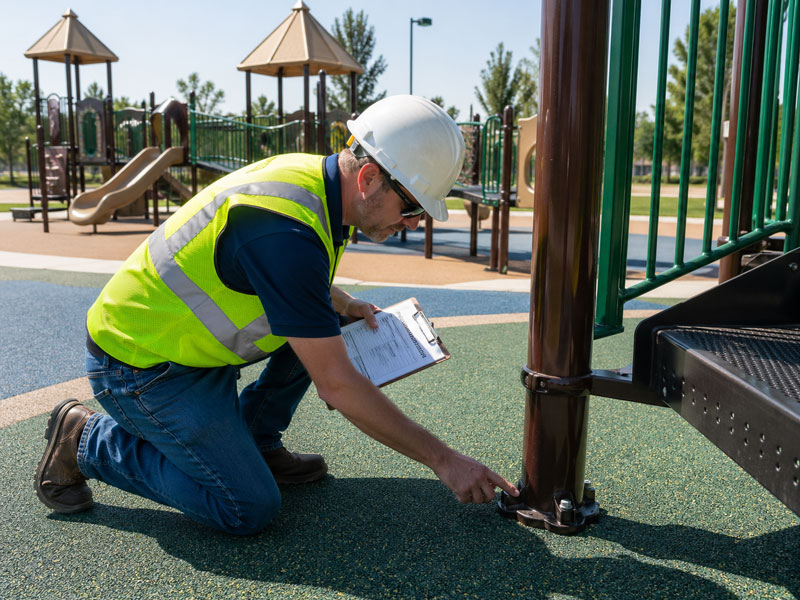
Commercial playground installation is a high-liability process that directly impacts child safety, regulatory compliance, and long-term maintenance costs. While many projects appear visually complete, underlying installation defects often go unnoticed until they result in injuries, equipment failure, or legal exposure.
From a certified playground inspector’s perspective, most safety risks originate not from design—but from improper installation practices.
This guide outlines the seven most critical red flags in commercial playground installation, along with practical insights to help developers, contractors, and facility owners mitigate risk.
1. Improper or Insufficient Playground Surfacing
Fall-related injuries account for the majority of playground accidents. That makes surfacing the single most important safety component.
A major red flag is inadequate impact-attenuating surfacing, including:
- Incorrect depth for loose-fill materials (e.g., engineered wood fiber)
- Uneven distribution in high-traffic zones
- Poor compaction or displacement over time
- Use of non-compliant materials
Certified inspectors typically evaluate surfacing based on critical fall height requirements. Any mismatch between equipment height and surface performance significantly increases injury risk.
2. Weak Equipment Anchoring or Structural Instability
All commercial playground equipment must be securely anchored to withstand dynamic loads, weather exposure, and repeated use.
Warning signs include:
- Visible post movement or wobbling
- Uneven vertical alignment
- Incomplete concrete footings
- Improper curing or soil preparation
Improper anchoring compromises the structural integrity of the entire system. In severe cases, it may lead to tipping hazards or progressive loosening of connected components.
3. Inadequate Use Zones and Clearance Violations
Every playground component requires a designated use zone—a safety perimeter where falls and movement occur.
Common installation errors:
- Equipment placed too close together
- Overlapping fall zones
- Insufficient clearance near swings or slides
- Obstructions such as fences, benches, or trees
Poor spacing increases collision risk and violates standard safety guidelines. This issue is particularly common in space-constrained projects attempting to maximize equipment density.
4. Poor Site Preparation and Drainage Design
A well-installed playground begins with proper ground preparation. Ignoring drainage considerations leads to long-term structural and safety problems.
Key red flags include:
- Standing water after rainfall
- Soft or unstable subgrade
- Erosion around footings
- Surface displacement due to water flow
Inadequate drainage not only degrades surfacing performance but also accelerates equipment wear and increases maintenance frequency.
5. Non-Compliance with Safety Standards
Commercial playgrounds must align with recognized safety frameworks such as ASTM F1487 and CPSC guidelines.
Indicators of non-compliance:
- Missing documentation or certifications
- Incorrect installation relative to manufacturer specifications
- Entrapment hazards or unsafe openings
- Misalignment with age-appropriate design zones
Compliance is not optional—it is a baseline requirement for liability protection and operational approval.
6. Poor Assembly Quality and Loose Hardware
Even high-quality playground equipment can become hazardous if assembled incorrectly.
Typical issues include:
- Loose bolts or fasteners
- Misaligned panels or joints
- Missing protective caps
- Inconsistent torque application
These defects often indicate broader installation quality issues. Over time, vibration and usage will amplify these weaknesses.
7. Lack of Post-Installation Inspection and Maintenance Plan
Installation is only the first phase of a playground’s lifecycle. A critical red flag is the absence of a structured inspection and maintenance protocol.
Best practices include:
- Routine visual inspections
- Periodic operational checks
- Scheduled surfacing replenishment
- Documentation of repairs and adjustments
Without a maintenance strategy, even a properly installed playground will degrade into a safety risk.
Certified Inspector Recommendations
From a professional inspection standpoint, high-quality playground installations share the following characteristics:
- Verified compliance with safety standards
- Properly engineered surfacing systems
- Accurate equipment layout with compliant spacing
- Stable and correctly anchored structures
- Complete installation documentation
- Clear maintenance and inspection guidelines
A proactive approach during installation significantly reduces long-term operational risk and cost.
Conclusion
Commercial playground installation is a technically sensitive process where small oversights can lead to significant safety hazards. The seven red flags outlined above—surfacing issues, weak anchoring, spacing violations, drainage failures, non-compliance, poor assembly, and lack of maintenance—represent the most common failure points observed in field inspections.
Addressing these issues during the installation phase ensures not only regulatory compliance but also user safety, equipment longevity, and reduced liability.
For developers and operators, adopting an inspection-driven mindset is the most effective way to deliver a safe and durable playground environment.
FAQ (SEO Optimized)
What is the most important factor in playground safety?
Proper surfacing is the most critical factor, as it directly reduces injury severity from falls.
How often should a commercial playground be inspected?
Routine visual inspections should occur weekly, with comprehensive inspections conducted quarterly or annually depending on usage.
What standards apply to playground installation in the U.S.?
ASTM F1487 and CPSC Public Playground Safety Handbook are widely used benchmarks for compliance.
What is a playground use zone?
A use zone is the designated space around equipment where children can safely fall or move without hitting obstacles.
Can poor installation void warranties?
Yes. Failure to follow manufacturer installation guidelines can void warranties and increase liability exposure.


